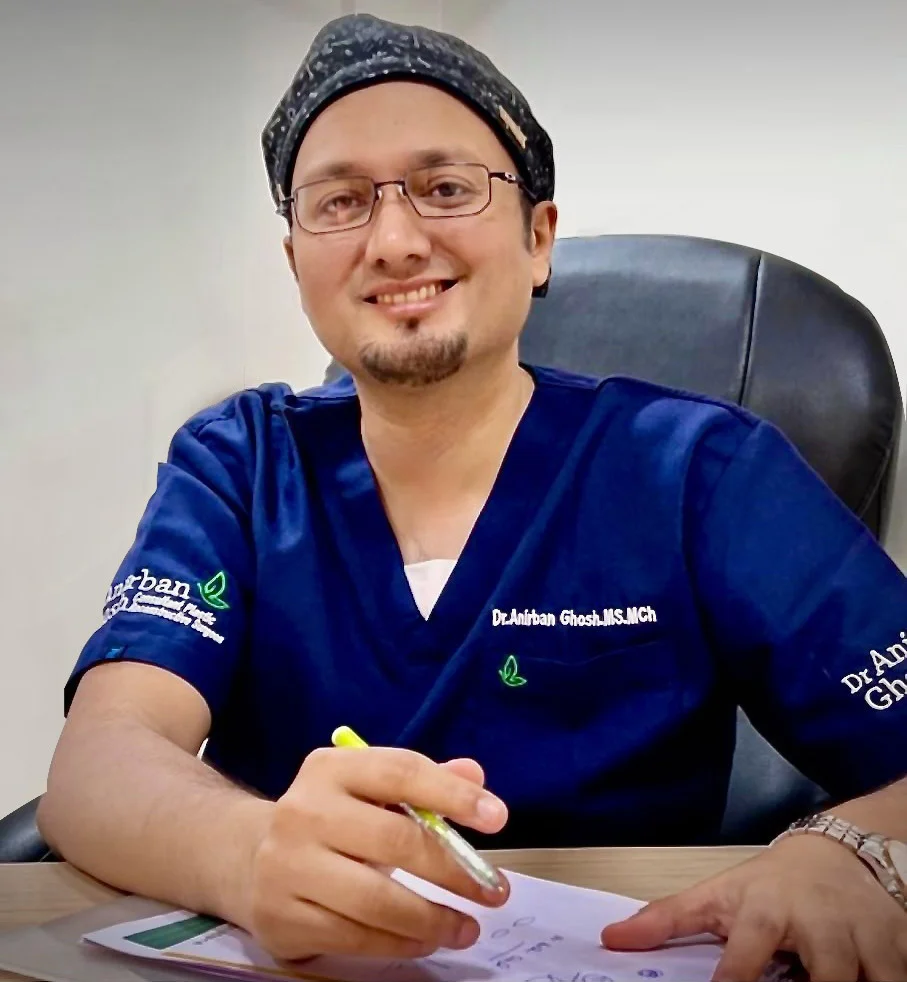
Eyelid Surgeon in Kolkata
Dr Anirban Ghosh — MCh Plastic Surgery | 15+ years | Anirvana Clinic, Ballygunge
Home / Surgical / Eyelid Surgery
What Is Eyelid Surgery (Blepharoplasty)?
Eyelid surgery (blepharoplasty) removes or repositions excess skin, muscle and fat around the eyes to restore a rested, open appearance — and in some cases to clear an obstructed field of vision. The single most important step happens before surgery: identifying which problem you actually have. Excess skin, a drooping lid muscle and a descended brow look similar in the mirror but need entirely different operations.
Upper vs. Lower Eyelid Surgery
| Upper eyelid surgery | Lower eyelid surgery | |
|---|---|---|
| Addresses | Hooding, heaviness, excess skin | Under-eye bags, puffiness, skin crepiness |
| Incision | Hidden in the natural lid crease | Inside the lid, or just under the lashes |
| Typical duration | 45–60 minutes | 60–90 minutes |
| Downtime | 7–10 days | 10–14 days |
Cosmetic vs. functional: where excess upper lid skin hangs far enough to obstruct the upper visual field, surgery is functional rather than cosmetic. This requires documented visual field testing, and only then may a portion be considered for insurance coverage. Purely aesthetic blepharoplasty is not covered.
Understanding Your Eyelid Concern
| Your concern | What is actually happening | What treats it |
|---|---|---|
Excess eyelid skin (dermatochalasis) |
Skin has stretched and now hangs over the crease | Upper blepharoplasty — skin excision |
True eyelid droop (ptosis) |
The lid margin itself sits low because the levator muscle attachment has weakened | Ptosis correction (levator surgery) — not blepharoplasty |
Brow descent |
The eyebrow has dropped, pushing lid skin downward | Brow lift — removing lid skin alone pulls the brow lower still |
Under-eye bags |
Orbital fat bulging through a weakened septum | Lower blepharoplasty — fat repositioning or conservative removal |
Under-eye hollows (tear trough) |
Volume loss and tethering, not excess tissue | Filler or fat grafting — removing fat makes hollows worse |
Ptosis is the one most often missed. If your lid margin — not just the skin above it — sits low over the coloured part of your eye, skin removal alone will leave you still looking droopy. It is measured at consultation, and it changes the entire operation.
What Eyelid Surgery Will Not Fix
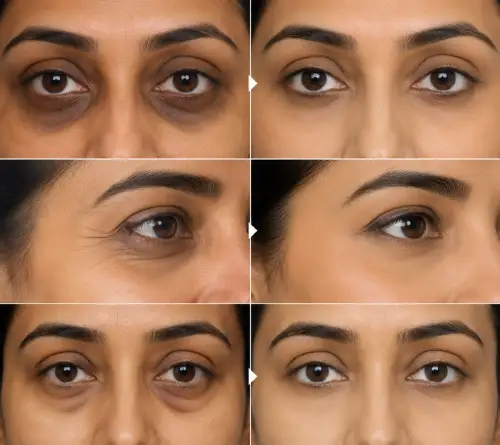
Dark circles from pigmentation. Periorbital hyperpigmentation is very common in Indian and South Asian skin and is usually constitutional or genetic. Surgery does not lighten it, and any clinic promising otherwise is misleading you.
Crow's feet and fine lines — these are dynamic muscle lines, treated with muscle relaxants, not surgery.
Puffiness from fluid retention, thyroid disease, kidney problems, allergy, poor sleep or high salt intake — these need medical assessment, not an operation.
Skin texture and quality.
Types of Eyelid Surgery
| Procedure | What it does |
|---|---|
Upper blepharoplasty |
Removes excess upper lid skin, sometimes a strip of muscle and a small amount of fat |
Lower blepharoplasty |
Corrects under-eye bags by repositioning or reducing fat, with conservative skin adjustment |
Ptosis correction (levator surgery) |
Tightens or reattaches the muscle that lifts the lid, raising the lid margin itself |
Double eyelid surgery (Asian blepharoplasty) |
Creates or defines an upper lid crease, respecting natural eyelid anatomy |
Epicanthoplasty |
Modifies the inner corner fold; performed conservatively because scarring here is difficult to hide |
Combined upper and lower |
Both lids in one operation, with a single recovery period |
Revision eyelid surgery |
Corrects over-resection, asymmetry, crease problems or lid malposition after previous surgery |
Surgical Techniques Explained
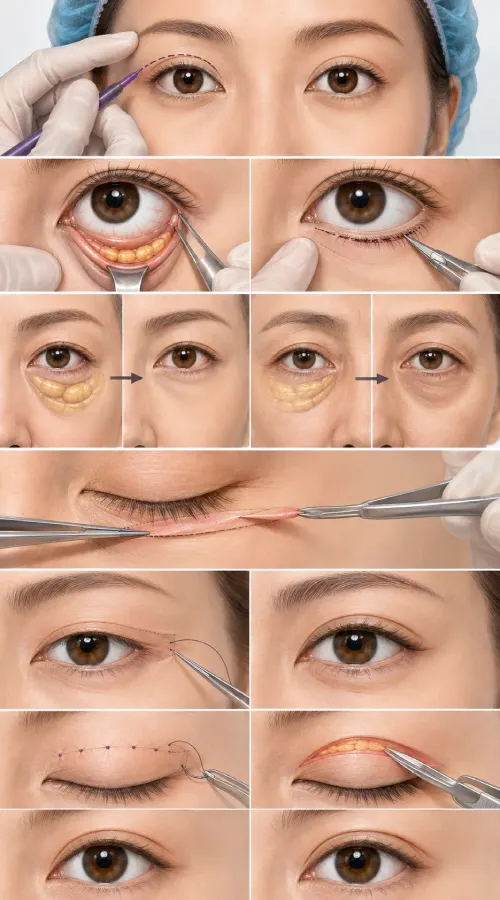
Upper lid crease planning and safe skin removal
The crease is marked with you sitting upright, eyes open. A minimum amount of skin must remain between the brow and lash line — removing too much causes permanent difficulty closing the eyes. Conservative removal that can be revised is always safer than aggressive removal that cannot be undone.
Lower lid: transconjunctival vs. transcutaneous
The transconjunctival approach works through the inside of the lid — no external scar, no skin removed, and a markedly lower risk of the lid pulling downward. The transcutaneous approach uses an incision just below the lashes and allows skin removal, but carries a higher risk of lid retraction.
Fat repositioning vs. fat removal
Where hollowing exists alongside bags, fat is repositioned into the hollow rather than discarded. Simply removing fat is what produces the hollow, skeletal look that ages the face — a common finding in revision cases.
Skin pinch technique
A conservative strip of skin only, often combined with a transconjunctival approach — the safest way to address fine lower lid skin excess.
Canthopexy and lid support
Where the lower lid is lax, it must be supported and tightened at the outer corner. Skipping this in a lax lid is a leading cause of the lid pulling away from the eye afterwards.
Incisional vs. non-incisional double eyelid methods
The suture (non-incisional) method has less downtime and is partly reversible but can loosen over time; it suits thin lids with minimal fat. The incisional method is more predictable and durable, and is needed where there is excess skin or thicker tissue.
Your Eye Examination Before Surgery
Eyelid surgery is surgery on the eye region, not on a cosmetic surface. A responsible consultation includes:
| Assessment | Why it matters |
|---|---|
Vision and visual field testing |
Establishes baseline and documents any functional obstruction |
Dry eye assessment |
Pre-existing dry eye is the strongest predictor of dry eye problems afterwards — and dryness is the most common complication |
Lower lid laxity testing |
A lax lid needs support at the same operation, or it will pull downward afterwards |
Brow position and facial assessment |
Determines whether the problem is the lid, the brow, or both |
Ptosis measurement |
Distinguishes a low lid margin from excess skin — a different operation |
Thyroid eye disease screening |
Operating on active thyroid eye disease can cause serious harm; it must be stable first |
Are You a Candidate for Eyelid Surgery?
Generally suitable: healthy, non-smoking or willing to stop, with a specific concern that surgery can address and realistic expectations.
Age and timing — cosmetic upper lid surgery is most often done from the late thirties onward, but hereditary under-eye bags and double eyelid surgery are commonly performed younger. Functional surgery is appropriate at any age once the visual field is affected.
Dry eye and contact lens wearers — existing dryness can worsen. This does not automatically rule out surgery, but it changes technique and how conservative the skin removal must be. Lenses stay out for around two weeks afterwards.
Previous LASIK or eye surgery — LASIK reduces tear production for a period. Surgery is usually deferred around six months, with careful tear film assessment first.
Disclose: thyroid disease, dry eye, glaucoma, previous eye or eyelid surgery, retinal problems, diabetes, high blood pressure, bleeding disorders or blood thinners, autoimmune conditions, myasthenia gravis (which can itself cause lid droop), and sleep apnoea.
Postpone or avoid with active thyroid eye disease, uncontrolled glaucoma, severe untreated dry eye, active eye or lid infection, uncontrolled hypertension, body dysmorphic disorder, or expectations surgery cannot meet.
Your Consultation and Planning
At consultation: standardised photographs in primary gaze, up-gaze, down-gaze and eyes closed · measurement of lid position, crease height, levator function and brow position · discussion of realistic outcomes, including what will not change · blood tests and blood pressure check · documented informed consent.
How to Prepare for Eyelid Surgery
- Pause blood thinners, aspirin, NSAIDs and supplements such as fish oil, vitamin E and ginkgo on your surgeon's schedule. Bleeding matters more here than almost anywhere else on the body — see retrobulbar haematoma below. Never stop prescribed medication on your own.
- Ensure blood pressure is well controlled before surgery.
- Stop smoking and nicotine 4 weeks before and after; avoid alcohol for a week either side.
- Plan 7–14 days before you are comfortable in public; longer if both lids are done.
- On the day: no eye makeup or contact lenses, bring dark glasses, reports and medication list, and arrange someone to take you home — your vision will be blurred.

Why Choose Dr Anirban Ghosh?
About the Surgeon
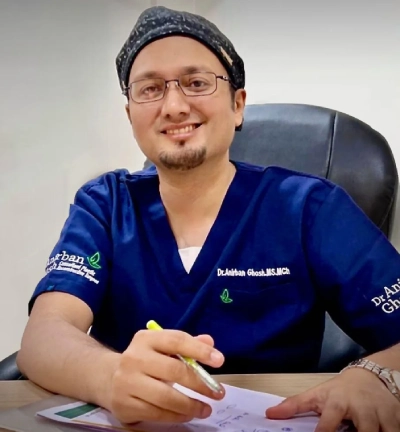
Dr. Anirban Ghosh
- MBBS (Gold Medallist)
- MS (General Surgery)
- MRCS (England)
- MCh (Aesthetic Plastic Surgery)
15+ Years of Experience
in aesthetic & reconstructive plastic surgery
50000+ Patients
Affiliations
- Indian Association of Aesthetic Plastic Surgeons (IAAPS)
- The Association of Plastic Surgeons of India (APSI)
Awards & Recognitions
- Honoured with the Indian Icon Best Healthcare Entrepreneur Award
- Esteemed Recipient of the Rabindra Ratna Puraskar 2025
The Procedure Step by Step
Marking
done sitting upright with eyes open, using a pinch technique to determine exactly how much skin can safely be removed.
Anaesthesia
usually local anaesthetic with sedation; general anaesthesia for extensive or combined procedures.
Incisions
upper lid within the natural crease; lower lid either inside the lid or just beneath the lashes.
Tissue adjustment
conservative skin removal, fat repositioned or reduced, lid support added where laxity exists, with meticulous control of every bleeding point.
Closure
very fine sutures, antibiotic ointment, no tight dressing, cold compresses started immediately.
Duration: upper lids 45–60 minutes · lower lids 60–90 minutes · combined 1.5–2.5 hours.
Discharge: same day.
Recovery After Eyelid Surgery
| Period | What to expect |
|---|---|
| Days 1–2 | Swelling, bruising, blurred vision from ointment, watering, tightness. Head elevated, cold compresses, no straining |
| Days 3–7 | Swelling peaks then eases. Sutures removed around day 5–7 |
| Week 2 | Most people return to work. Bruising fading and usually concealable |
| Weeks 3–4 | Swelling substantially settled; scars remain pink |
| Week 6 | Most swelling resolved; result becoming apparent |
| Months 3–6 | Scars mature and fade; final result settles |
Practical rules:
Use prescribed drops and ointment as directed
Cold compresses for the first 48 hours, not ice directly on skin
Limit screen time for the first few days — concentrating reduces blinking and worsens dryness
Driving once vision is clear and you are off sedating medication, usually about a week
Eye makeup only after sutures are out and wounds have sealed, around two weeks
Contact lenses around two weeks
Sunglasses and sun protection for scars.
Do not: rub or press the eyes · bend, strain or lift heavy weights for 2–3 weeks · swim until wounds are fully healed · judge symmetry before six weeks, since each side swells differently.
Risks and Complications
| Complication | Notes |
|---|---|
| Expected effects | Swelling, bruising, dryness, watering, temporary blurred vision, tightness |
| Dry eye and irritation | The most common complication; usually temporary but can persist, especially with pre-existing dryness |
| Lagophthalmos | Difficulty closing the eyes fully, from removing too much skin; risks corneal exposure and needs prompt management |
| Ectropion / lower lid retraction | The lower lid pulls away or downward, showing white below the iris — usually from skin over-resection or unaddressed lid laxity |
| Chemosis | Swelling of the transparent membrane over the eye; more common after lower lid surgery and can take weeks to settle |
| Asymmetry and crease problems | Uneven, high, low or double creases; a leading reason for revision |
| Over-resection and hollowing | A skeletal, hollowed look that reads as older, not younger. Difficult to correct and usually needs fat grafting |
| Infection | Uncommon, given the excellent blood supply |
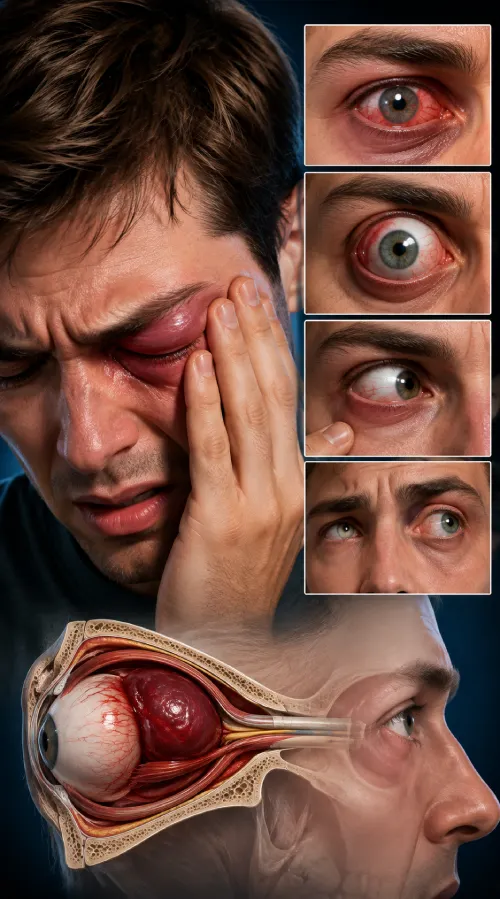
Retrobulbar Haematoma — Know These Signs
This is a rare complication that can cause permanent blindness, and it is treatable if addressed immediately. Bleeding builds up behind the eye and compresses the optic nerve. It is uncommon, and typically occurs within the first 24–48 hours.
Go to an emergency department immediately — do not wait for a morning appointment — if you develop:
Severe or rapidly increasing pain in or behind the eye
Any loss or change of vision
A bulging, hard or tense eye
Inability to move the eye normally, or double vision
Rapidly spreading, tense swelling with pain
Sight can be saved by urgent surgical decompression within hours. This is why blood pressure control, stopping blood thinners as instructed, avoiding straining, and having a 24-hour contact number all matter.
Also seek prompt review for fever, spreading redness, wound discharge, or inability to close the eyelids.
Revision surgery is generally deferred for at least six months, once swelling has fully resolved, and scar tissue has softened.
Eyelid Surgery vs. Non-Surgical Options
| Option | Can do | Cannot do |
|---|---|---|
| Muscle relaxant injections | Soften crow's feet; modest lift of the brow tail | Remove skin, fat or bags |
| Tear trough filler | Fill under-eye hollows and soften the shadow | Remove bags or excess skin |
| Laser / radiofrequency tightening | Improve fine lines and mild skin quality | Replace skin excision or address fat |
Tear trough filler carries genuine risk. The under-eye area has a rich, delicate blood supply, and accidental injection into a vessel can cause skin damage and, rarely, permanent vision loss. It can also produce a bluish tinge, lumpiness or prolonged swelling that lasts months. It should only be performed by an experienced medical injector using dissolvable hyaluronic acid, with hyaluronidase available on site.
Combining is common and sensible — surgery for skin and fat, injectables for dynamic lines, volume replacement for hollows.
Surgery is the only option where there is significant excess skin, true fat prolapse causing bags, ptosis of the lid margin, or obstruction of the visual field.
Combining Eyelid Surgery with Other Procedures
Brow lift — where brow descent is the real cause of upper lid heaviness. Doing lid surgery alone in this situation lowers the brow further.
Facelift or mid-face lift — addresses cheek and mid-face descent, which contributes to the under-eye shadow that lower lid surgery alone will not correct.
Fat grafting around the eyes — restores volume in hollow areas. Technically demanding here: the skin is very thin, and irregularities show, so small volumes and staged sessions are the safe approach.
Choosing an Eyelid Surgeon in Kolkata
Look for MCh or DNB (Plastic Surgery), or an ophthalmologist with oculoplastic fellowship training. Both routes are legitimate. Verify registration on the NMC or State Medical Council register. More about Dr Anirban Ghosh.
Ask: Will you examine my eyes and test my tear film? Is my problem skin, ptosis, or my brow? Will I need lower lid support? How much skin are you removing, and what is left? What happens if I develop severe pain or vision change overnight? What is your revision policy?
Red flags:
- no eye examination or dry eye testing
- ptosis not distinguished from excess skin
- promises to remove dark circles
- "thread lifts" offered for eyelids
- non-clinical premises
- a fixed price quoted without examination
- guaranteed results
- pressure to book on the day.
Book a consultation for an individual assessment.
Visiting Our Clinic in Kolkata
Anirvana Clinic
8/29 Fern Road, Ballygunge Gardens, Gariahat Kolkata, West Bengal 700019
Phone
+91 6289109687
Consultation hours
| Day | Hours |
|---|---|
| Monday | 10:00 am – 10:30 pm |
| Tuesday – Saturday | 9:00 am – 9:30 pm |
| Sunday | Closed |
Hours may vary on public holidays.
Areas served
Patients travel to the Ballygunge clinic from Gariahat, Ballygunge, Dhakuria, Rashbehari, Kasba, Jadavpur, Tollygunge, Alipore, Park Street, Salt Lake, New Town, Behala, Howrah and across South and North Kolkata — as well as from Durgapur, Asansol, Siliguri and other districts of West Bengal, and from Bihar, Jharkhand, Odisha and Assam.
Travelling from outside Kolkata? Discuss the follow-up schedule before booking travel.
Frequently Asked Questions (FAQs)
What is the difference between droopy eyelids and excess eyelid skin?
Excess skin (dermatochalasis) hangs over the crease and is removed by blepharoplasty. True ptosis means the lid margin itself sits low because the lifting muscle has weakened, and it needs levator surgery instead. They look similar but are different operations.
Will eyelid surgery remove your dark circles?
No. Dark circles from pigmentation are common in Indian skin and are usually constitutional. Surgery addresses skin, fat and lid position — not pigment.
Is eyelid surgery painful?
Most patients report tightness and pressure rather than pain, well controlled with simple painkillers. Watering and blurred vision from ointment are more bothersome than discomfort.
How long is the recovery?
Sutures come out at day 5–7, and most people return to work by two weeks. Swelling largely settles by six weeks, with the final result at three to six months.
Will the scars be visible?
Upper lid scars sit within the natural crease and are usually very difficult to see once healed. Lower lid surgery through the inside of the lid leaves no external scar at all.
Can eyelid surgery improve your vision?
Yes, where excess upper lid skin obstructs the upper visual field. This is documented by visual field testing before surgery.
Is it covered by insurance?
Only the functional component, with documented visual field obstruction and supporting assessment. Cosmetic eyelid surgery is not covered. Seek written pre-authorisation.
Can you have surgery if you already have dry eyes?
Often yes, but it changes the plan — more conservative skin removal and careful pre-operative tear film assessment. Untreated severe dry eye is a reason to postpone.
How long do the results last?
Upper eyelid results are long-lasting, often ten years or more, though ageing continues. Lower eyelid fat correction is generally durable, since the fat removed or repositioned does not return.
When can you wear eye makeup again?
Around two weeks, once sutures are out and the wounds have fully sealed. Use fresh products and remove them gently.
When can you use screens or drive?
Screens can be used briefly from a few days, but limit sessions early on because reduced blinking worsens dryness. Driving is usually possible after about a week, once vision is clear.
What is the most serious risk?
Retrobulbar haematoma — bleeding behind the eye. It is rare but can threaten sight, and requires emergency treatment within hours. Severe pain, vision change or a bulging eye means going straight to an emergency department.
Can double eyelid surgery be reversed?
The non-incisional suture method is partly reversible. The incisional method is permanent, though the crease can sometimes be revised by an experienced surgeon.
Will you look like a different person?
No. Well-planned eyelid surgery makes you look rested rather than altered. Dramatic change usually signals over-resection, which is the outcome to avoid.
What does eyelid surgery cost in Kolkata?
It depends on whether one or both lids are treated, whether ptosis correction is needed, anaesthesia type and facility. Request a written, itemised estimate at consultation.
Request An Appointment
Visit us
Anirvana Clinic
Ballygunge, Kolkata — just off Rash Behari Avenue
References and Medical Sources
- American Society of Plastic Surgeons (ASPS) — Blepharoplasty clinical guidance.
- American Society of Ophthalmic Plastic and Reconstructive Surgery (ASOPRS) — Eyelid surgery and ptosis resources.
- American Academy of Ophthalmology (AAO) — Blepharoplasty and functional visual field criteria.
- Royal College of Ophthalmologists — Guidance on oculoplastic surgery and dry eye assessment.
- Published literature on the incidence and management of retrobulbar haemorrhage following blepharoplasty.
- Published literature on periorbital hyperpigmentation in South Asian skin.
- Association of Plastic Surgeons of India (APSI) — Practice standards.
- National Medical Commission — Registration verification and professional conduct regulations.