Liposuction Surgeon in Kolkata
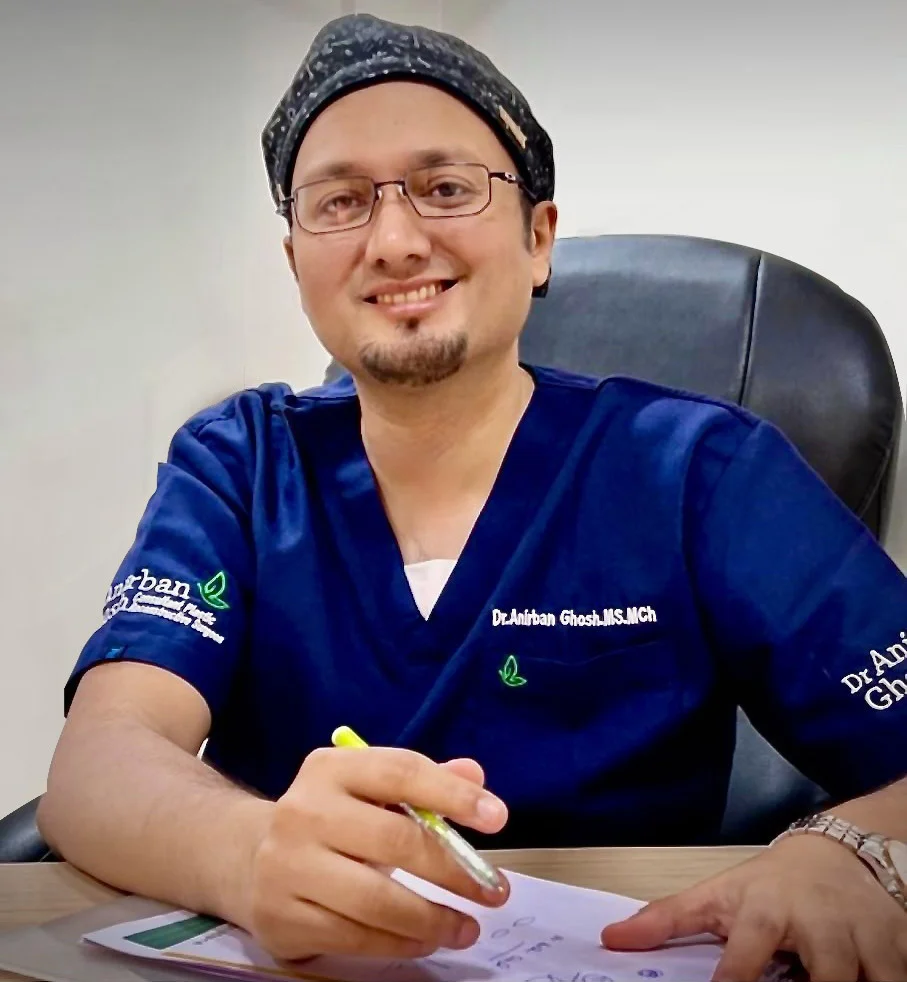
Dr Anirban Ghosh — MCh Plastic Surgery | 15+ years | Anirvana Clinic, Ballygunge
Home / Surgical / Liposuction
What Is Liposuction?
Liposuction removes localised deposits of fat beneath the skin using a fine cannula and suction, to reshape body contour. It is a body-contouring operation, not a weight-loss treatment. It works best for stubborn bulges that resist diet and exercise, in people already close to a stable, healthy weight and with reasonable skin elasticity.
What Liposuction Can and Cannot Do
| Liposuction can | Liposuction cannot |
|---|---|
| Remove localised, diet-resistant subcutaneous fat | Remove visceral fat around your organs |
| Improve body proportion and contour | Tighten loose or hanging skin |
| Reduce fibrous fat in the back, flanks and male chest | Treat cellulite (it can occasionally look worse) |
| Harvest fat for fat grafting elsewhere | Treat obesity or replace diet and exercise |
| Refine areas after weight loss | Guarantee perfect symmetry |
Why Liposuction Is Not a Weight-Loss Procedure
The fat removed usually weighs far less than patients expect, and the number on the scale often barely moves. More importantly, liposuction removes only subcutaneous fat — the fat under the skin. It does not touch visceral fat, the deep fat around the organs that carries the metabolic and cardiovascular risk. Liposuction changes your shape, not your health status or your weight category.
If weight loss is the goal, that comes first. Liposuction refines what remains once your weight is stable.
Are You a Good Candidate for Liposuction?
Ideal Weight and BMI Range
Generally suitable: stable weight for 3–6 months · BMI in a healthy or modestly overweight range · localised bulges resistant to diet and exercise · good skin elasticity · non-smoker or willing to stop · medically fit · realistic expectations.
Why Skin Elasticity Determines Your Result
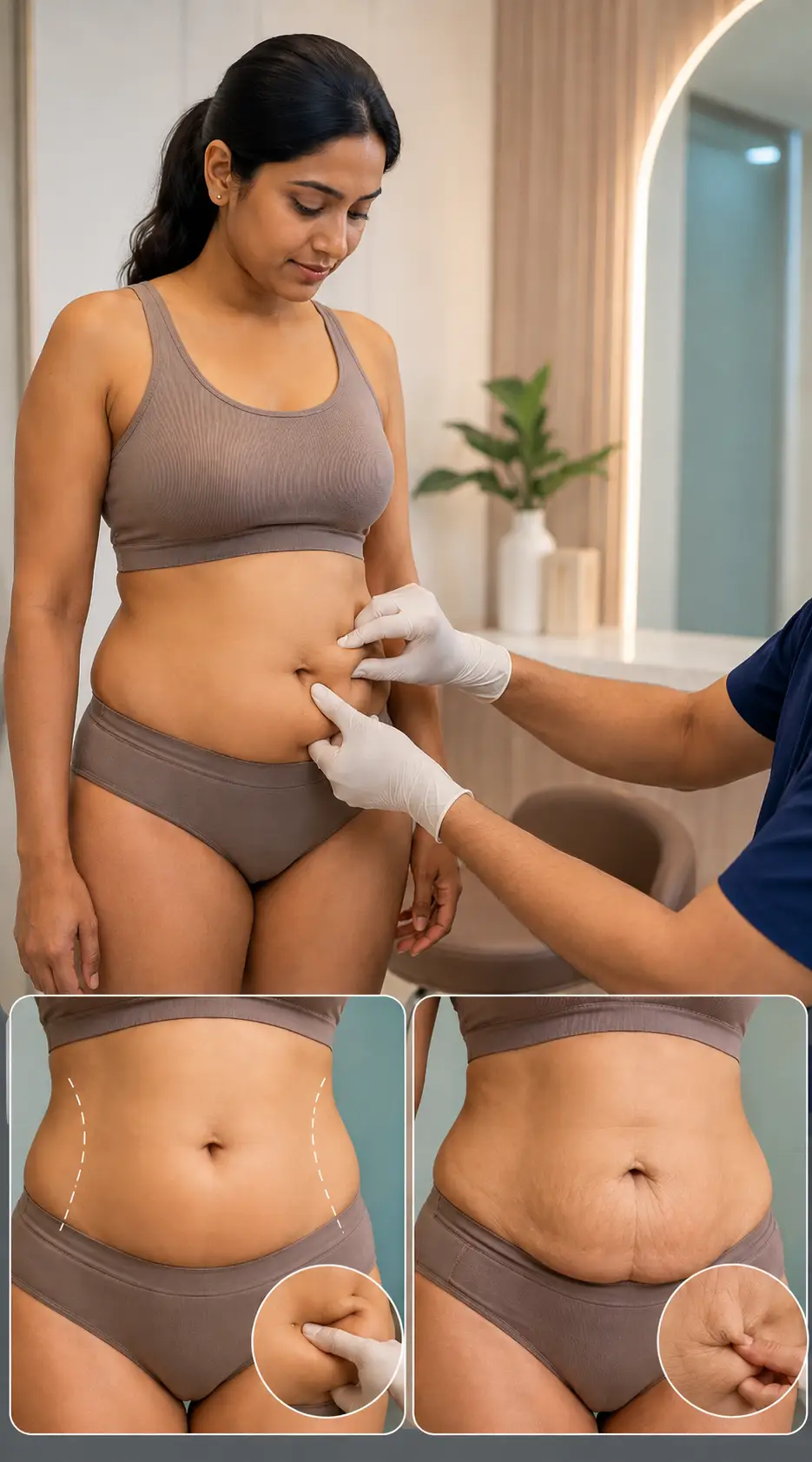
This is the single most under-discussed factor. Liposuction removes what is under the skin; the skin must then shrink back on its own. Where elasticity is good, it redrapes smoothly. Where it is poor — after pregnancy, after significant weight loss, with age, sun damage or established stretch marks — removing the fat underneath leaves loose, hanging skin, and the result can look worse than before.
Your surgeon should assess this by pinch and recoil testing at consultation and tell you honestly if skin removal is the better operation.
When You Need a Tummy Tuck Instead
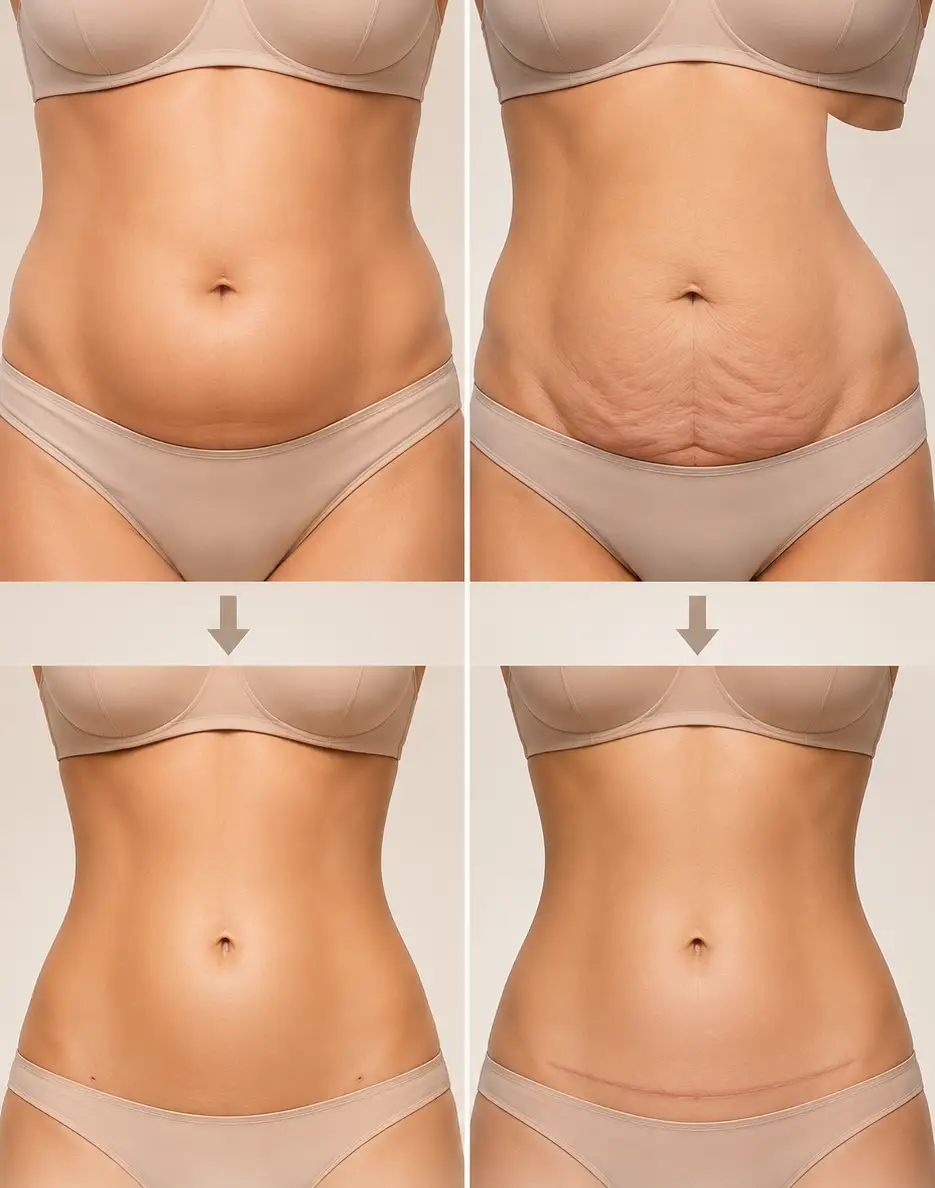
Consider abdominoplasty rather than liposuction alone if you have significant loose abdominal skin, an overhanging apron of skin, separation of the abdominal muscles (rectus diastasis) after pregnancy, or extensive stretch marks below the navel. Liposuction cannot address any of these.
Who Should Not Have Liposuction
- Anyone seeking it as a weight-loss method, or with an unstable weight
- Significant heart, lung, liver or kidney disease; uncontrolled diabetes or hypertension
- Bleeding or clotting disorders, or ongoing anticoagulation
- Active smokers unwilling to stop
- Pregnancy or breastfeeding
- Active infection
- Body dysmorphic disorder or expectations that surgery cannot meet
Setting Realistic Expectations
Liposuction delivers improvement, not perfection. Minor contour irregularities and small asymmetries are common, swelling masks the result for months, and a proportion of patients need a touch-up procedure.
Body Areas Treated with Liposuction
| Area | Notes |
|---|---|
Abdomen and flanks |
The most commonly treated area; flanks ("love handles") respond well |
Inner and outer thighs |
Outer thighs respond reliably; inner thigh skin is thinner and laxity limits results |
Upper arms |
Good where skin tone is good; otherwise an arm lift is needed |
Back and bra roll |
Fibrous, dense fat — usually needs power- or ultrasound-assisted technique |
Chin and neck (submental) |
Small volume, high visual impact; depends heavily on skin and jawline support |
Male chest |
Often true gynecomastia, where glandular tissue must be excised — liposuction alone leaves a firm disc behind the nipple |
Buttocks, hips and calves |
Calves and ankles are technically demanding with prolonged swelling |
Liposuction 360 |
Circumferential treatment of abdomen, flanks and back. Longer operation, larger volume, more swelling — and it must be planned within safe volume limits, not sold as an unlimited package |
Types of Liposuction Techniques
Tumescent technique is the foundation of all modern liposuction, not a separate option. Dilute local anaesthetic with adrenaline and saline is infiltrated first — this numbs the area, constricts blood vessels to reduce blood loss, and separates the fat for easier removal.
| Technique | How it works | Best suited to |
|---|---|---|
SAL (suction-assisted) |
Manual cannula with vacuum | Standard, versatile, well-proven |
PAL (power-assisted) |
Rapidly vibrating cannula | Fibrous areas, larger volumes, efficient removal |
UAL / VASER (ultrasound-assisted) |
Ultrasound emulsifies fat before removal | Dense fibrous fat, male chest, revision cases; may aid skin retraction |
Laser-assisted |
Laser energy liquefies fat | Small areas; skin-tightening claims are modest and thermal injury is a real risk |
WAL (water-assisted) |
Pressurised fluid jet dislodges fat | Gentle removal; good quality fat for grafting |
High-definition / abdominal etching |
Selective superficial removal to reveal muscle shadows | Lean, athletic patients with excellent skin — high technical risk of permanent visible irregularity if judged wrongly |
Which is right for you depends on the area, how fibrous the fat is, the volume planned, your skin quality and whether the fat is being grafted elsewhere. No device compensates for surgical judgement. Be wary of clinics marketing a branded machine as the deciding factor — the surgeon's assessment and technique determine the result far more than the equipment.
Liposuction Safety: What You Should Know Before Choosing a Doctor
This is the most important section on this page. Liposuction is a real surgical operation, and serious harm — including death — has occurred when it has been performed by unqualified practitioners in unequipped premises. The risk is largely avoidable through proper training, setting and monitoring.
Who Is Qualified to Perform Liposuction in India
MCh or DNB in Plastic Surgery is the recognised superspecialty qualification. Verify registration on the NMC or State Medical Council register — it is publicly searchable and takes two minutes. Liposuction offered by practitioners without surgical qualification, or in non-clinical premises, is not safe regardless of price or marketing.
Where Your Surgery Should Be Performed
An accredited hospital or accredited day-care surgical facility with a proper operating theatre, a qualified anaesthetist, full resuscitation equipment, oxygen, blood availability for larger cases, and a defined ICU transfer protocol. Not a salon, spa, or consulting room.
Anaesthesia and Intra-Operative Monitoring
A qualified consultant anaesthetist should manage general anaesthesia or sedation, with continuous ECG, oxygen saturation, blood pressure, capnography and temperature monitoring, plus fluid balance and active patient warming throughout.
Tumescent Fluid and Lidocaine Safety Limits
Tumescent technique allows a higher total lidocaine dose than conventional local anaesthesia, but the limit is weight-based and must be calculated for each patient — not estimated. Blood levels peak many hours after infiltration, so toxicity can appear late, after discharge. Early signs include tingling around the mouth, a metallic taste, ringing in the ears, dizziness or confusion; severe toxicity causes seizures and cardiac arrhythmias. Report any of these immediately, even the day after surgery.
How Much Fat Can Be Safely Removed in One Session
Around 5 litres of aspirate is the widely accepted threshold beyond which a case is classed as large-volume and carries substantially higher risk. Exceeding this to satisfy a patient request is poor practice. Where more contouring is needed, staging the surgery across separate sessions is safer than one large operation.
Large-Volume Liposuction: Additional Precautions
- Overnight admission with monitoring
- careful intravenous fluid balance
- haematocrit checks
- warming
- and a lower threshold for extending observation.
Blood Clot (VTE) Risk Assessment and Prevention
Deep vein thrombosis and pulmonary embolism are among the most serious risks. Mitigation includes a formal risk assessment (such as a Caprini score), calf compression devices during surgery, early walking afterwards, and blood-thinning medication where indicated. Combining liposuction with other procedures — abdominoplasty, a mommy makeover — meaningfully increases this risk and requires deliberate assessment, not routine bundling. Tell your surgeon if you take hormonal contraception or HRT.
Fat Embolism: What It Is and How Risk Is Minimised
Rare, but serious: fat entering the bloodstream and lodging in the lungs or brain, typically presenting within 24–72 hours with breathlessness, low oxygen levels or confusion. Risk rises with large-volume removal. Where fat is grafted to the buttock, it must be placed in the subcutaneous layer only — never into muscle, which is the practice associated with the highest mortality of any aesthetic procedure.
Emergency Protocols and Post-Operative Cover
Ask directly: who do I contact at 2 a.m.? Is the operating surgeon reachable? Which hospital would I be taken to? A clinic without a clear answer is not equipped to manage a complication.
Your Consultation and Pre-Operative Workup
Assessment
examination of fat distribution, pinch and skin-recoil testing, muscle tone, hernias, previous scars, measurements and standardised clinical photographs.
Disclose fully
diabetes, heart or lung disease, thrombosis or clotting history, liver or kidney disease, thyroid disorders, previous surgery or liposuction, all medications, hormonal contraception or HRT, supplements, and smoking or alcohol use. Omissions here directly affect your safety.
Investigations
full blood count, clotting profile, liver and kidney function, blood sugar or HbA1c, ECG and further cardiac or respiratory assessment as indicated, plus a pre-anaesthetic review.
Informed consent
a documented discussion of the expected result, the possibility of revision, and the specific risks below.
Why Choose Dr Anirban Ghosh?
About the Surgeon
Dr. Anirban Ghosh
- MBBS (Gold Medallist)
- MS (General Surgery)
- MRCS (England)
- MCh (Aesthetic Plastic Surgery)
15+ Years of Experience
in aesthetic & reconstructive plastic surgery
50000+ Patients
Affiliations
- Indian Association of Aesthetic Plastic Surgeons (IAAPS)
- The Association of Plastic Surgeons of India (APSI)
Awards & Recognitions
- Honoured with the Indian Icon Best Healthcare Entrepreneur Award
- Esteemed Recipient of the Rabindra Ratna Puraskar 2025
How to Prepare for Liposuction
- Stop smoking and nicotine at least 4 weeks before and after — it impairs healing and raises skin and wound complications.
- Pause blood thinners, aspirin, NSAIDs and supplements such as fish oil, vitamin E, ginkgo and high-dose garlic on your surgeon's schedule. Never stop prescribed medication on your own.
- Discuss hormonal contraception or HRT — these affect clot risk.
- Avoid alcohol for a week either side.
- Plan 1–2 weeks off work; longer for physical roles or larger cases.
- On the day: fast as instructed, wear loose dark clothing, bring your compression garment, reports and medication list, and arrange someone to drive you home and stay the first night.

The Liposuction Procedure Step by Step
Marking
done standing, mapping every treatment zone and blending area. This is where the result is designed.
Anaesthesia
general anaesthesia, or sedation with tumescent local for smaller areas.
Tumescent infiltration
the fluid is instilled and allowed 10–15 minutes to take effect.
Incisions
3–5 mm, positioned in creases and hidden lines.
Aspiration and contouring
fat is removed in overlapping cross-tunnelling passes, deep layers first, feathering into untreated areas so there is no visible step.
Symmetry check
the patient is repositioned, often sat up, and both sides compared before closing.
Closure and garment
fine sutures, sometimes left partly open to drain, then the compression garment is fitted on the table.
Duration: 1–4 hours depending on the number of areas.
Discharge: same day for smaller cases; overnight for larger volumes or combined procedures.
Recovery After Liposuction
| Period | What to expect |
|---|---|
| First 48 hours | Soreness, bruising, and blood-stained fluid leaking from the incisions — this is expected and not bleeding. Garment worn continuously; walk short distances hourly while awake |
| Week 1 | Peak swelling and bruising. Tightness and firmness normal. Light activity only |
| Weeks 2–4 | Most people return to desk work between days 5–10. Bruising fading; swelling persists |
| Months 2–3 | Exercise resumes gradually — light cardio from 2–3 weeks, strenuous activity from 4–6 weeks |
| Months 3–6 | Swelling resolves and the final contour appears. Thighs, ankles and large-volume cases take the longest |
Compression garments: typically 4–6 weeks — continuously for the first 2–4 weeks, then daytime only. Wearing it properly measurably improves contour and reduces swelling.
Lymphatic drainage massage: often recommended from around 1–2 weeks. Evidence is modest, but many patients find it reduces swelling and firmness. Only with your surgeon's clearance.
Do: walk regularly from day one · stay hydrated · eat protein · sleep as advised · attend every follow-up.
Don't: panic about lumpiness at 4–6 weeks (normal healing) · skip the garment · sit still for long periods · resume heavy training early · judge your result before three months.
Risks and Complications
| Complication | Notes |
|---|---|
| Expected effects | Swelling, bruising, numbness, soreness, fluid leakage, temporary firmness |
| Contour irregularity, dents, waviness | The most common aesthetic complication; risk rises with superficial and high-definition technique |
| Loose skin | Where elasticity was poor to begin with; may need a skin-excision procedure |
| Seroma and haematoma | Fluid or blood collection; may need aspiration or drainage |
| Infection | Uncommon; treated with antibiotics, occasionally drainage |
| Numbness and nerve injury | Common temporarily; usually resolves over weeks to months |
| Asymmetry and revision | Minor asymmetry is common; a touch-up procedure is sometimes needed, usually not before 6 months |
| Serious but rare | Blood clots and pulmonary embolism · fat embolism · local anaesthetic toxicity · fluid overload · skin necrosis · abdominal wall or organ injury · very rarely, death |
Seek immediate medical attention for chest pain or breathlessness · calf pain or swelling · fever or spreading redness · heavy bleeding · severe abdominal pain · confusion or dizziness · reduced urine output · or tingling around the mouth, metallic taste or ringing in the ears.
Are Liposuction Results Permanent?
Fat cells removed by liposuction do not grow back in that area. The treated zone keeps a permanently reduced number of fat cells.
However, the fat cells that remain can still enlarge. If you gain significant weight afterwards, you will gain it — just in a different distribution, often more noticeably in untreated areas, because the treated zone has less capacity. This is why a stable weight matters more after liposuction than before it.
Maintaining your result: keep weight within a few kilos of your post-operative weight · regular exercise, including resistance training · consistent eating patterns · and remember that pregnancy, menopause and some medications will change body fat distribution regardless of surgery.

Liposuction vs. Other Options
| Liposuction | Tummy tuck | |
|---|---|---|
| Removes fat | Yes | Yes (limited) |
| Removes loose skin | No | Yes |
| Repairs muscle separation | No | Yes |
| Scars | 3–5 mm marks | Long hip-to-hip scar |
| Recovery | 1–2 weeks | 4–6 weeks |
vs. non-surgical fat reduction (cryolipolysis, radiofrequency, HIFU, injection lipolysis): these produce modest reduction over multiple sessions with no incisions and minimal downtime. They suit small, localised areas in people close to their goal. They cannot match surgical liposuction for volume, precision or predictability, and they do not remove skin.
vs. weight loss and bariatric surgery: liposuction is not an alternative to either. For significant obesity, medical or surgical weight management comes first; contouring follows once weight has been stable for 6–12 months.
Combined with fat grafting: fat removed from one area can be purified and transferred to the face, breast or buttock. Some resorption is expected, so results are staged.
Within a mommy makeover: liposuction is often combined with abdominoplasty and breast surgery. Combining procedures reduces total downtime but increases operative time, clot risk and complication rates — suitable only for carefully selected, fit patients.
Choosing a Liposuction Doctor in Kolkata
MCh or DNB (Plastic Surgery) is the qualification to look for. Verify it on the NMC or State Medical Council register. Read more about Dr Anirban Ghosh.
Ask: What is your qualification and registration number? Which facility will you operate in, and is it accredited? Who gives the anaesthesia? How many litres are you planning to remove? Am I a candidate for liposuction alone, or do I need skin removal? What is your revision policy and cost? Who do I contact overnight if something goes wrong?
Red flags: liposuction offered by non-surgeons or in salon or spa premises · "lunchtime liposuction" with no anaesthetist · unlimited-area or unlimited-litre packages · fixed prices quoted without examination · guaranteed results or guaranteed weight loss · pressure to book immediately · quotes given by sales staff rather than the operating surgeon · before-and-after photos that are not the surgeon's own work.
Book a consultation for an individual assessment and a written, itemised estimate.
Visiting Our Clinic in Kolkata
Anirvana Clinic
8/29 Fern Road, Ballygunge Gardens, Gariahat Kolkata, West Bengal 700019
Phone
+91 6289109687
Consultation hours
| Day | Hours |
|---|---|
| Monday | 10:00 am – 10:30 pm |
| Tuesday – Saturday | 9:00 am – 9:30 pm |
| Sunday | Closed |
Hours may vary on public holidays.
Areas served
Patients travel to the Ballygunge clinic from Gariahat, Ballygunge, Dhakuria, Rashbehari, Kasba, Jadavpur, Tollygunge, Alipore, Park Street, Salt Lake, New Town, Behala, Howrah and across South and North Kolkata — as well as from Durgapur, Asansol, Siliguri and other districts of West Bengal, and from Bihar, Jharkhand, Odisha and Assam.
Travelling from outside Kolkata? Discuss the follow-up schedule before booking travel.
Frequently Asked Questions (FAQs)
Is liposuction a weight-loss surgery?
No. It removes localised subcutaneous fat to reshape contour. It does not remove visceral fat, does not significantly change body weight, and is not an obesity treatment.
How much fat can be removed in one session?
Around 5 litres of aspirate is the widely accepted safety threshold. Beyond that, risk rises sharply and overnight monitoring is required. Staging surgery across sessions is safer than exceeding the limit.
Will the fat come back?
Not in the treated area — those fat cells are gone permanently. Remaining fat cells elsewhere can still enlarge with weight gain, so gains tend to show in untreated areas.
Does liposuction tighten loose skin?
No. Skin must retract on its own. Where elasticity is poor, removing fat can make skin laxity more obvious, and a skin-removal procedure is the better option.
Is liposuction painful?
Most patients describe deep soreness and stiffness, similar to intense exercise, for the first week. It is generally well controlled with oral painkillers.
When can you return to work?
Usually between days 5 and 10 for desk work. Physical jobs and larger-volume cases need longer.
How long do you wear the compression garment?
Typically 4–6 weeks — continuously at first, then daytime only. Compliance genuinely affects the final contour.
When will you see your final result?
Improvement is visible within weeks, but swelling takes 3–6 months to fully resolve. Thighs, ankles and large-volume cases can take longer.
Does liposuction remove cellulite?
No. Cellulite is caused by fibrous bands tethering the skin, not by fat volume, and liposuction can occasionally make dimpling more noticeable.
Can you have liposuction and a tummy tuck together?
Often yes, but combining procedures lengthens surgery and raises clot and complication risk. It requires careful patient selection and formal risk assessment.
Are you too heavy for liposuction?
Liposuction works best near a stable, healthy weight. At higher BMIs, the aesthetic benefit is smaller and the risk greater, so weight management usually comes first.
Is VASER better than ordinary liposuction?
It is better suited to dense, fibrous fat and revision cases, not universally superior. The surgeon's judgement matters far more than the device.
What are the warning signs after surgery?
Breathlessness, chest pain, calf pain or swelling, fever, spreading redness, severe abdominal pain, confusion, or tingling around the mouth. Seek medical help immediately.
Will I have scars?
Only 3–5 mm marks at the cannula entry points, placed in creases and natural lines. They usually fade substantially but never disappear entirely.
What does liposuction cost in Kolkata?
It depends on the number and size of areas, technique, operating time, anaesthesia and facility, and whether an overnight stay is needed. Request a written, itemised estimate at consultation.
Request An Appointment
Visit us
Anirvana Clinic
Ballygunge, Kolkata — just off Rash Behari Avenue
References and Medical Sources
- American Society of Plastic Surgeons (ASPS) — Practice advisory and evidence-based guidelines on liposuction.
- International Society of Aesthetic Plastic Surgery (ISAPS) — Patient safety guidance in body contouring.
- Klein JA — Tumescent technique and lidocaine pharmacokinetics in liposuction.
- Caprini JA — Venous thromboembolism risk assessment in surgical patients.
- Aesthetic Surgery Education and Research Foundation / Multi-Society Gluteal Fat Grafting Task Force — Safety recommendations on fat grafting to the buttock.
- Association of Plastic Surgeons of India (APSI) — Practice standards and scope of practice.
- National Accreditation Board for Hospitals and Healthcare Providers (NABH) — Standards for day-care surgical facilities.
- National Medical Commission — Registration verification and professional conduct regulations.