
Dermal Fillers Treatment in Kolkata
Dr Anirban Ghosh — 15+ years | Anirvana Clinic, Ballygunge
Home / Non Surgical / Dermal Fillers
What Are Dermal Fillers?
Dermal fillers are injectable gels placed beneath the skin to restore lost volume, soften folds and refine facial contour. Most are made from hyaluronic acid, a sugar molecule the skin produces naturally. Results are visible immediately, last months rather than permanently, and hyaluronic acid fillers can be dissolved if needed. They are a medical procedure with real risks, and who injects them matters far more than what they cost.
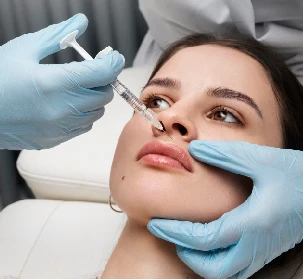
How Dermal Fillers Work Under the Skin
Filler is placed at a specific depth — sometimes just under the skin, sometimes deep against bone — depending on the area and the product. It works in three ways: adding volume directly, binding water to hydrate and plump tissue, and with some products stimulating your own collagen over the following months.
Fillers Are Not Botox: The Key Difference
| Dermal fillers | Botulinum toxin | |
|---|---|---|
| What it does | Adds volume and structure | Relaxes muscle movement |
| Treats | Volume loss, folds, contour, definition | Dynamic lines caused by expression |
| Typical areas | Cheeks, lips, jawline, chin, temples, tear trough | Forehead, frown lines, crow's feet |
| Onset | Immediate | 3–7 days, peak at 2 weeks |
| Lasts | 6–24 months | 3–4 months |
| Reversible | Hyaluronic acid — yes | No, it wears off |
The two are frequently combined because they solve different problems.
Types of Dermal Fillers
| Type | How it works | Typical use | Reversible |
|---|---|---|---|
Hyaluronic acid (HA) |
Adds volume, binds water | Almost all areas; softer gels for lips and tear trough, firmer for jaw and chin | Yes — dissolvable with hyaluronidase |
Calcium hydroxylapatite (CaHA) |
Volume plus collagen stimulation | Jawline, deep folds, hands | No |
Poly-L-lactic acid (PLLA) |
Collagen stimulator; result builds gradually over months across a series of sessions | Broad volume restoration, temples, cheeks | No |
Permanent fillers are strongly discouraged. Products that cannot be dissolved or removed carry a lifelong risk of late nodules, migration and inflammatory reactions, and complications can appear years afterwards with limited treatment options.
Facial Areas Treated with Dermal Fillers
| Area | Typical volume | Notes |
|---|---|---|
Lips |
0.5–1 ml | Start conservative; build across sessions |
Cheeks and midface |
1–2 ml per side | Often the most effective single area — lifting the midface improves folds below it |
Under-eye / tear trough |
0.5–1 ml total | High-risk area. Needs an experienced injector; not suitable where the problem is bags rather than hollows — see eyelid surgery |
Nasolabial folds and marionette lines |
1–2 ml | Frequently better addressed by restoring cheek support first |
Jawline |
2–4 ml | Firmer products; definition rather than bulk |
Chin |
1–2 ml | Improves profile balance and can reduce a "heavy" lower face |
Temples |
1–2 ml | High-risk area — important vessels run superficially here |
Non-surgical nose reshaping |
0.3–0.8 ml | The highest-risk area on the face. Can camouflage a small hump or lift the tip. It cannot make the nose smaller, narrow it or improve breathing — for that, see surgical rhinoplasty |
Hands |
1–2 ml per hand | Restores volume over tendons and veins |
Earlobes |
0.5 ml | Softens stretched or thinned lobes |
Who Is a Good Candidate for Dermal Fillers?
You may benefit if you have:
Flattening of the cheeks
Deepening folds around the mouth
Hollow temples or under-eyes
An undefined jawline or receding chin
Thin or asymmetric lips
Downturned mouth corners.
Age
Most patients are between their late twenties and fifties. Fillers restore volume that has been lost — they are less appropriate in very young patients who have not lost any.
Who Should Avoid Fillers — Contraindications
Pregnancy or breastfeeding
Active skin infection, acne or a cold sore at the treatment site
Known hypersensitivity to the product or to lidocaine
Bleeding disorders or anticoagulant therapy (relative — needs assessment)
Active autoimmune or connective tissue disease (relative)
History of severe allergy or anaphylaxis
Permanent filler already present in the area — this substantially complicates both treatment and any future complication
Body dysmorphic disorder, or expectations that injectables cannot meet
How Much Filler Will You Need?
One millilitre is roughly a fifth of a teaspoon. Most people significantly underestimate how small that is, which is why a single syringe rarely transforms a whole face and why honest volume planning matters at consultation.
Why More Filler Is Not Better
Overfilling does not look younger — it looks heavy, puffy and distorted. It stretches tissue, encourages migration, and gradually changes proportions in a way that is obvious to others before it is obvious in the mirror. The safer approach is staged: treat conservatively, review at two weeks once swelling has settled, and add if needed. Filler is easy to add and harder to take away.
The Dermal Filler Procedure at Anirvana Clinic
Consultation and facial mapping — assessing the whole face in three dimensions, not just the area you point at. Often the best result comes from treating somewhere other than where you noticed the problem.
Product selection and consent — product, batch and lot number, volume and injection sites all documented before starting.
Cleansing and topical numbing — thorough antiseptic preparation, then topical anaesthetic for 20–30 minutes. Most HA fillers also contain local anaesthetic.
Injection: needle or cannula — a blunt cannula reduces the risk of entering a blood vessel and is preferred in higher-risk areas such as the tear trough, temples and nasolabial region. A needle allows finer precision where appropriate. Either way: slow injection, low pressure, small amounts at a time.
Shaping and symmetry check — you sit upright and review with a mirror before the session ends.
Aftercare briefing — written instructions and a contact number for urgent concerns outside clinic hours.
Why Choose Dr Anirban Ghosh?
About the Surgeon
Dr. Anirban Ghosh
- MBBS (Gold Medallist)
- MS (General Surgery)
- MRCS (England)
- MCh (Aesthetic Plastic Surgery)
15+ Years of Experience
in aesthetic & reconstructive plastic surgery
50000+ Patients

Affiliations
- Indian Association of Aesthetic Plastic Surgeons (IAAPS)
- The Association of Plastic Surgeons of India (APSI)
Awards & Recognitions
- Honoured with the Indian Icon Best Healthcare Entrepreneur Award
- Esteemed Recipient of the Rabindra Ratna Puraskar 2025
How to Prepare for Your Filler Appointment
Pause blood thinners, aspirin, NSAIDs, fish oil, vitamin E and ginkgo for about a week where your doctor agrees it is safe. This reduces bruising. Never stop prescribed medication on your own.
Avoid alcohol for 24 hours beforehand.
Timing matters: leave two weeks either side of dental work (dental procedures release bacteria into the bloodstream, which can seed filler), two weeks around vaccinations or illness, and book at least two to four weeks before any major event so swelling and bruising have fully settled.
Tell us about cold sores before lip treatment — preventive antiviral medication is often advisable.

Recovery and Aftercare Timeline
| Period | What to expect |
|---|---|
First 24 hours |
Swelling, redness, tenderness, occasional small bruises |
Days 2–3 |
Peak swelling — lips in particular can look considerably fuller than the final result |
Days 4–7 |
Swelling settling, shape becoming apparent |
Week 2 |
Final result. This is when to assess and decide about any top-up |
Do:
- Apply cold compresses
- Sleep slightly elevated for the first night or two
- Cleanse gently
- Stay hydrated.
Don't:
- Massage the area unless specifically instructed
- Exercise strenuously for 24–48 hours
- Use saunas, steam rooms or hot yoga for 1–2 weeks
- Have facials, laser or dental work for 2 weeks
- Drink alcohol for 24 hours
- Sleep face-down the first night
- Judge the result before two weeks.
How Long Do Dermal Fillers Last?
| Area | Typical duration |
|---|---|
| Lips | 6–12 months (constant movement breaks product down faster) |
| Tear trough | 9–18 months |
| Cheeks and midface | 12–18 months |
| Jawline and chin | 12–24 months |
| Temples | 12–18 months |
| Nose | 9–18 months |
| Hands | 12–18 months |
Fillers break down faster with a fast metabolism, frequent intense exercise, smoking, sun exposure, high-movement areas, and softer, less cross-linked products.
When to top up: generally before the product has fully disappeared — often around 9–12 months for most areas. Maintaining a result usually needs less product than rebuilding one from scratch.
Risks, Complications and Our Safety Protocol
Common and temporary: swelling, redness, bruising, tenderness, small palpable lumps that settle, and mild asymmetry that evens out within two weeks.
Vascular Occlusion — Know These Signs
Vascular occlusion happens when filler blocks or compresses a blood vessel and cuts off blood supply to the skin. Left untreated, it causes tissue death and permanent scarring. Treated promptly with hyaluronidase, it usually resolves fully.
Contact the clinic immediately — do not wait for your review appointment — if you notice:
Severe pain or out of proportion, especially pain that increases rather than settles
A white or blanched patch of skin
Dusky, purple, mottled or net-like discolouration
Skin that feels cool, or is slow to turn pink after being pressed
Blistering or crusting developing over the following days
Signs can appear during the injection or hours afterwards. Treatment is time-critical.

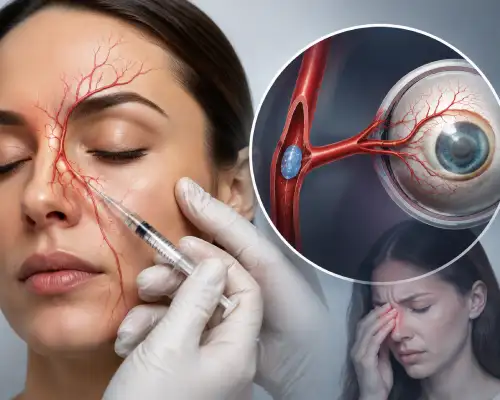
Vision Complications
Extremely rare, but serious: filler entering an artery that connects to the eye's circulation can cause partial or permanent vision loss. Sudden vision change, eye pain, severe headache or nausea after treatment is a medical emergency — go to hospital immediately and take your treatment record with you.
Highest-risk zones: the nose, the area between the eyebrows, the tear trough, the temples and the forehead. These areas demand an injector who knows the vascular anatomy in detail and injects accordingly.
Other Complications
Migration — product moving from where it was placed, most recognisably lip filler drifting above the lip border. Prevented by correct depth, appropriate product choice, conservative volume, and adequate intervals between sessions rather than repeated topping up.
Nodules and delayed reactions — lumps can appear early (usually technique or product related) or months later as a delayed inflammatory response, sometimes triggered by illness, dental infection or vaccination. Treatable, but needs proper medical assessment rather than reassurance.
Infection — uncommon, and why sterile technique and the dental-work interval matter.
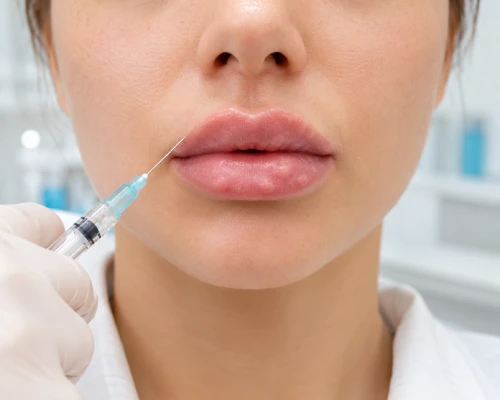

Our Emergency Protocol
Hyaluronidase is kept on site, up to date, in every treating room, with a written vascular occlusion protocol and staff trained to follow it. Ask any clinic this question directly before treatment — a clinic that does not stock hyaluronidase, or cannot explain its protocol, is not equipped to manage the complication it may cause.
Why Anatomical Training Matters More Than Price?
Facial blood vessels do not follow identical paths in every person. Safe injecting depends on knowing the danger zones, choosing the right depth and instrument, aspirating where appropriate, injecting slowly at low pressure in small amounts, and recognising a complication within minutes. Cheap filler injected by an untrained person in a non-medical setting is the single highest-risk scenario in aesthetic medicine — and it is the scenario behind most of the serious harm reported in this field.

Can Dermal Fillers Be Dissolved or Reversed?
Yes — hyaluronic acid fillers can be dissolved with hyaluronidase, an enzyme that breaks down HA within hours to days. It is used both in emergencies and when someone simply dislikes their result.
It does not work on calcium hydroxylapatite, poly-L-lactic acid or permanent fillers — one of the strongest arguments for choosing HA.
After dissolving: expect swelling and an area that looks temporarily deflated or loose. Some of your own natural hyaluronic acid is affected too, but this regenerates. Wait around two weeks before considering re-treatment. Allergy to hyaluronidase is rare but possible, so it is administered in a medical setting.
Dermal Fillers vs. Other Treatments
| What it does best | Downtim | Duration | |
|---|---|---|---|
| Dermal fillers | Restores volume and contour | 1–2 days | 6–24 months |
| Botulinum toxin | Softens expression lines | None | 3–4 months |
| Fat grafting | Larger-volume restoration using your own tissue | 1–2 weeks | Long-lasting, with partial resorption |
| Facelift | Lifts and removes lax skin | 2–4 weeks | Years |
Fillers cannot lift sagging skin. Adding volume to compensate for laxity is the classic route to an overfilled, heavy face. Where the issue is loose skin rather than lost volume, surgery is the honest answer.
Combining treatments is common and usually sequenced rather than done all at once — toxin and filler often at the same visit, with energy-based treatments such as microneedling RF or PRP spaced two weeks apart from filler to avoid disturbing settling product.
Book a consultation for an individual assessment.
Visiting Our Clinic in Kolkata
Anirvana Clinic
8/29 Fern Road, Ballygunge Gardens, Gariahat Kolkata, West Bengal 700019
Phone
+91 6289109687
Consultation hours
| Day | Hours |
|---|---|
| Monday | 10:00 am – 10:30 pm |
| Tuesday – Saturday | 9:00 am – 9:30 pm |
| Sunday | Closed |
Hours may vary on public holidays.
Areas served
Patients travel to the Ballygunge clinic from Gariahat, Ballygunge, Dhakuria, Rashbehari, Kasba, Jadavpur, Tollygunge, Alipore, Park Street, Salt Lake, New Town, Behala, Howrah and across South and North Kolkata — as well as from Durgapur, Asansol, Siliguri and other districts of West Bengal, and from Bihar, Jharkhand, Odisha and Assam.
Travelling from outside Kolkata? Discuss the follow-up schedule before booking travel.
Frequently Asked Questions (FAQs)
Do Dermal Fillers Hurt?
Most people describe pressure and brief stinging rather than pain. Topical anaesthetic is applied beforehand, and most HA fillers contain local anaesthetic, so discomfort is generally mild.
How Soon Will You See Results?
Immediately, though swelling masks the true outcome for several days. The settled result appears at around two weeks.
How Long Do Fillers Last?
Between 6 and 24 months depending on the area and product — shortest in the lips, longest in the jawline and chin.
Are Dermal Fillers Safe?
They are safe when performed by a trained medical injector using genuine, registered product with hyaluronidase available. Most serious complications reported involve untrained injectors, non-medical settings or counterfeit products.
What is Vascular Occlusion?
A blocked blood vessel caused by filler. Signs include disproportionate pain, blanching, dusky or mottled discolouration and cool skin. It is treatable with hyaluronidase, but treatment is urgent.
Can Fillers Cause Blindness?
Very rarely, if the product enters an artery connected to the eye's circulation. Risk is highest in the nose, between the brows, the tear trough, the temples and the forehead — which is why these areas require an experienced injector.
Can Fillers Be Removed if You Don't Like Them?
Hyaluronic acid fillers can be dissolved with hyaluronidase within hours to days. Calcium hydroxylapatite, poly-L-lactic acid and permanent fillers cannot.
Will Fillers Make Your Face Look Puffy?
Not when volumes are conservative and staged. Puffiness comes from overfilling — which is why building gradually across sessions is safer than a large single treatment.
Do Fillers Stretch Your Skin?
Excessive, repeated overfilling can stretch tissue over time. Sensible volumes and adequate intervals between treatments avoid this.
Can You Get Fillers Before a Wedding or Event?
Yes, but book at least two to four weeks ahead so swelling and bruising have fully resolved. Never schedule filler in the same week as an important event.
Can You Have Fillers if You’re Pregnant or Breastfeeding?
No. Fillers are not administered during pregnancy or breastfeeding as safety has not been established.
How Much Filler Do You Need?
It depends entirely on the area and your anatomy — roughly 0.5–1 ml for lips, 1–2 ml per cheek, 2–4 ml for a jawline. Your assessment will give a specific plan.
Is Filler Better Than a Facelift?
They do different things. Fillers restore volume; a facelift lifts and removes lax skin. Neither substitutes for the other.
Can Fillers Fix Your Nose Without Surgery?
They can camouflage a small hump or slightly lift the tip. They cannot reduce size, narrow the nose or improve breathing, and the nose is the highest-risk area on the face for injection.
Request An Appointment
Visit us
Anirvana Clinic
Ballygunge, Kolkata — just off Rash Behari Avenue
References and Medical Sources
- U.S. Food and Drug Administration — Dermal filler safety communications, including vascular occlusion and vision loss.
- Central Drugs Standard Control Organisation (CDSCO) — Medical device registration in India.
- Beleznay K et al. — Avoiding and treating blindness from fillers, Dermatologic Surgery.
- ACE Group World / IMCAS — Consensus guidance on managing vascular occlusion and hyaluronidase protocols.
- American Society of Plastic Surgeons (ASPS) — Injectable filler clinical guidance.
- Published literature on delayed inflammatory reactions to hyaluronic acid fillers.
- Association of Plastic Surgeons of India (APSI) — Practice standards.
- National Medical Commission — Registration verification and professional conduct regulations.