
Female Breast Reduction Doctor in Kolkata
Reduction mammoplasty for women, performed by Dr Anirban Ghosh, MCh-qualified plastic surgeon with over 15 years in breast surgery.
Home / Surgical / Female Breast Reduction
What is Breast Reduction Surgery?
Female breast reduction, or reduction mammoplasty, is a surgical procedure that removes excess breast fat, glandular tissue, and skin to reduce breast size and reshape the breast. It is most often performed to relieve neck, back, and shoulder pain caused by disproportionately heavy breasts.
For many women, large breasts are not a cosmetic concern but a daily physical one — persistent shoulder grooving from bra straps, upper back pain, recurring rashes in the inframammary fold, and difficulty exercising. Reduction mammoplasty addresses the cause directly by reducing breast weight and repositioning the remaining tissue higher on the chest wall. Because the nipple-areola complex is also lifted during the procedure, breast reduction produces a lift as an inherent part of the operation. Most women do not need a separate breast lift.
This is a different procedure from male breast reduction, or gynecomastia surgery, which treats enlarged male breast tissue and uses different techniques.
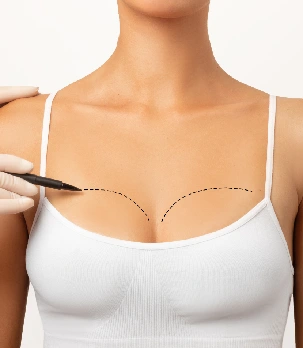
What Are the Types of Breast Reduction Surgery?
There are four main breast reduction techniques: inverted-T (anchor), vertical (lollipop), liposuction-only, and free nipple graft. The right one depends on how much tissue needs removing, how much the breast has descended, and your skin quality. Your surgeon selects the technique at consultation.
Inverted-T (Anchor) Breast Reduction
- Best for: Large reductions with significant sagging
- Duration: 3–4 hours
- Hospital stay: 1 night
- Return to desk work: 2–3 weeks
- Full recovery: 6 weeks
- Anaesthesia: General
- Scar: Around the areola, vertically down, and along the breast crease
Vertical (Lollipop) Breast Reduction
- Best for: Small to moderate reductions with mild to moderate sagging
- Duration: 2–3 hours
- Hospital stay: Day care or 1 night
- Return to desk work: 2 weeks
- Full recovery: 4–6 weeks
- Anaesthesia: General
- Scar: Around the areola and vertically down — no crease scar
Liposuction-Only Breast Reduction
- Best for: Breasts that are predominantly fatty, with good skin elasticity and minimal sagging
- Duration: 1–2 hours
- Hospital stay: Day care
- Return to desk work: 1 week
- Full recovery: 3–4 weeks
- Anaesthesia: General, or local with sedation
- Scar: Two to four small cannula-entry scars, each a few millimetres
- Important: This technique reduces volume but does not lift the breast or reshape it significantly. Only a minority of women are suitable candidates.
Free Nipple Graft Reduction
- Best for: Very large reductions (gigantomastia) where blood supply to the nipple cannot be safely preserved on a pedicle
- Duration: 3–4 hours
- Hospital stay: 1–2 nights
- Full recovery: 6–8 weeks
- Anaesthesia: General
- Scar: Anchor pattern
- Important: The nipple is removed and grafted back into position. Nipple sensation is permanently lost and breastfeeding is not possible afterwards. This technique is reserved for cases where it is the safest option.
Related: Breast lift surgery if sagging rather than size is your main concern · Liposuction
Before/After Results of Breast Reduction
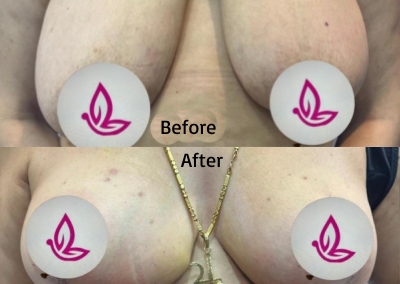

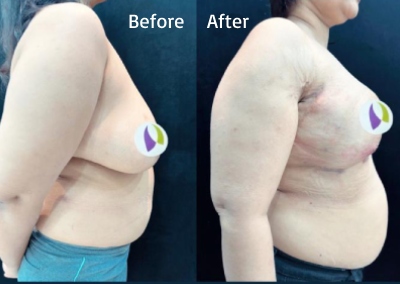
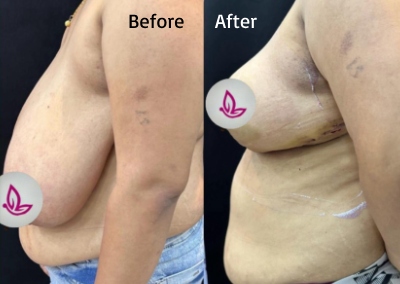
How Is Breast Reduction Surgery Performed, Step by Step?
Breast reduction is performed under general anaesthesia and takes two to four hours. The surgeon makes pre-planned incisions, removes excess fat, glandular tissue, and skin, repositions the nipple-areola complex on its blood supply, and reshapes and closes the breast. Most women go home the next day.

Step-1
Consultation & Assessment
Dr Ghosh examines and measures your breasts, discusses how much reduction you want, reviews your medical history, and takes standardised photographs. He explains which technique suits you and where your scars will be.

Step-2
Pre-Operative Preparation
Routine blood tests and an anaesthetic fitness review are arranged. A mammogram or breast ultrasound is advised if you are over 40, or at any age if you have a family history of breast cancer or a palpable lump. You will be asked to stop smoking for at least four weeks before and after surgery, as nicotine substantially raises the risk of wound breakdown and nipple loss.

Step-3
Anaesthesia
General anaesthesia is administered by a consultant anaesthetist, who monitors you throughout. You will be asleep and pain-free for the entire operation.

Step-4
Incision Planning and Creation
Markings are made while you are standing, before anaesthesia, to ensure symmetry. Incisions follow the planned pattern — around the areola, vertically, and along the breast crease if required.

Step-5
Tissue Removal & Nipple Preservation
Excess skin, fat, and glandular tissue are removed. The nipple-areola complex stays attached to a pedicle of tissue that carries its blood and nerve supply, so it is repositioned rather than detached — except in free nipple graft cases. Removed tissue is sent for routine histopathology.

Step-6
Nipple & Areola Repositioning
The nipple-areola complex is moved to its new position on the reshaped breast mound. The areola is usually reduced in diameter at the same time.

Step-7
Shaping & Wound Closure
The remaining breast tissue is shaped into a natural contour, and the incisions are closed in layers with dissolvable sutures. Drains may be placed depending on the technique.

Step-8
Immediate Recovery
You wake in the recovery room and are monitored for a few hours. Nipple colour and circulation are checked closely during the first 24 hours.

Step-9
Discharge & Follow-Up
Most patients go home within 24 hours. Follow-up is at one week, three weeks, three months and one year. The histopathology report is discussed at your first follow-up.

Step-10
Healing & Scar Maturation
A surgical support bra is worn continuously for six weeks. Scars are red and firm initially, soften from around three months, and continue fading for 12 to 18 months. Silicone gel or sheeting and sun protection improve final scar quality.
What Are the Benefits of Breast Reduction Surgery?
Breast reduction reliably relieves neck, back, and shoulder pain, resolves shoulder grooving and skin irritation beneath the breasts, and makes exercise and daily activity easier. Studies consistently rank it among the highest-satisfaction procedures in plastic surgery, with reported satisfaction typically above 90 per cent.
Relief from chronic neck, upper back and shoulder pain
Resolution of bra-strap shoulder grooving
Clearing of intertrigo — the rash and irritation in the fold beneath the breast
Easier exercise and physical activity
Improved posture and body alignment
Better-fitting clothing and bras
More balanced breast proportion and improved symmetry
Lift achieved as part of the same procedure
Benefits are well documented, but outcomes vary among individuals. Dr Ghosh will discuss what is realistically achievable for your body at the consultation.

Why Choose Dr Anirban Ghosh?
About the Surgeon
Dr. Anirban Ghosh
- MBBS (Gold Medallist)
- MS (General Surgery)
- MRCS (England)
- MCh (Aesthetic Plastic Surgery)
15+ Years of Experience
in aesthetic & reconstructive plastic surgery
50000+ Patients

Affiliations
- Indian Association of Aesthetic Plastic Surgeons (IAAPS)
- The Association of Plastic Surgeons of India (APSI)
Awards & Recognitions
- Honoured with the Indian Icon Best Healthcare Entrepreneur Award
- Esteemed Recipient of the Rabindra Ratna Puraskar 2025
Which Type of Breast Reduction Is Right for You?
Inverted-T suits large reductions with significant sagging. Vertical suits small to moderate reductions with good skin quality and leaves a shorter scar. Liposuction-only suits fatty breasts with minimal sagging. Free nipple graft is reserved for very large reductions where nipple blood supply cannot be safely preserved.
| Aspect | Inverted-T (Anchor) | Vertical (Lollipop) | Liposuction-Only | Free Nipple Graft |
|---|---|---|---|---|
| Reduction volume | Large to very large | Small to moderate | Small, volume only | Very large |
| Addresses sagging | Yes, extensively | Yes, moderately | No | Yes |
| Scar pattern | Areola + vertical + crease | Areola + vertical | 2–4 small entry points | Areola + vertical + crease |
| Nipple sensation | Usually preserved; some change common | Usually preserved | Preserved | Permanently lost |
| Breastfeeding potential | Often retained, not guaranteed | Often retained, not guaranteed | Usually retained | Not possible |
| Recovery to desk work | 2–3 weeks | 2 weeks | 1 week | 3 weeks |
| Full recovery | 6 weeks | 4–6 weeks | 3–4 weeks | 6–8 weeks |
| Complication profile | Highest of the four; still low overall | Lower | Lowest | Higher; graft-specific risks |
| Best suited to | Large, sagging breasts needing significant reshaping | Moderate size, good skin elasticity | Predominantly fatty breasts, minimal sagging | Gigantomastia where nipple pedicle is unsafe |
This table is a general guide. Technique selection depends on measurements taken during physical examination and cannot be decided from a website or from photographs.
How Long Does Recovery After Breast Reduction Take?
Most women return to desk work in two to three weeks and to full exercise at six weeks. Swelling settles substantially by six weeks, but the breasts take three to six months to reach their final shape. Scars continue to fade for 12 to 18 months.
First 48 hours
- Rest with your upper body elevated
- Prescribed pain relief taken regularly, not only when pain peaks
- Drains, if placed, are usually removed before discharge or at day 2
- Short, gentle walks around the house from the evening of surgery to reduce clot risk
Week 1
- Swelling and bruising are at their peak
- Surgical support bra worn day and night
- Keep incisions clean and dry; no soaking baths
- No lifting above shoulder height, nothing heavier than 2 kg
- First follow-up appointment
Week 2–3
- Return to desk-based work for most patients
- Bruising fades, and swelling begins to settle
- Driving usually possible once you can perform an emergency stop without pain
- Gentle shoulder mobility exercises
Week 4-6
- Light activity — walking, stationary cycling, gentle yoga
- Still no heavy lifting, running, or chest-loading exercise
- Scar management begins once incisions are fully healed: silicone gel or sheeting, plus sun protection
- Watch for signs of infection: increasing redness, warmth, fever, or discharge
3 months & beyond
- Breasts settle into their final shape; you can be fitted for normal bras
- Full return to all exercise including chest training
- Altered nipple sensation, if present, may continue improving up to 12 months
- Scars continue to soften and fade through 12–18 months
Recovery timelines are typical, not guaranteed. Healing is slower in smokers, in patients with diabetes, and after larger reductions.
When Is Breast Reduction Surgery Needed?
Breast reduction is considered when breast weight causes persistent physical symptoms — neck, back or shoulder pain, shoulder grooving from bra straps, recurring rashes beneath the breasts, or restricted physical activity — that have not improved with supportive bras, physiotherapy or weight management.
You may be a candidate if you have:
Persistent neck, upper back or shoulder pain related to breast weight
Permanent shoulder grooving or indentation from bra straps
Recurring rash, irritation or infection in the fold beneath the breasts
Difficulty exercising or participating in sport
Postural changes attributable to breast weight
Significant breast asymmetry
Ongoing psychological distress relating to breast size
Difficulty finding clothing or correctly fitting bras
Surgery may need to be deferred or reconsidered if you:
Are currently pregnant or breastfeeding — wait at least six months after stopping
Smoke and are unwilling to stop for four weeks before and after surgery
Have not reached a stable weight, or plan significant weight loss
Are planning pregnancy in the near future and wish to preserve breastfeeding capacity
Have uncontrolled diabetes, a bleeding disorder, or a significant untreated cardiac or respiratory condition
Have an undiagnosed breast lump — this must be investigated first
Have expectations that cannot be met surgically
What Are the Risks of Breast Reduction Surgery?
Breast reduction is a safe, well-established operation, but every surgical procedure carries risk. The most common issues are altered nipple sensation, delayed wound healing at the junction of incisions, and asymmetry. Serious complications such as nipple loss are uncommon and reduced by careful technique and stopping smoking.
Common, usually temporary
- Swelling, bruising and discomfort
- Altered or reduced nipple and skin sensation
- Delayed healing at the T-junction of incisions
- Temporary asymmetry while swelling settles
Less common
- Infection at the incision sites
- Seroma or haematoma — fluid or blood collection requiring drainage
- Hypertrophic or keloid scarring, more likely in patients with a personal or family history
- Persistent asymmetry in breast or nipple position requiring revision
- Fat necrosis producing firm lumps within the breast
Uncommon but serious
- Partial or complete nipple-areola loss — the risk rises sharply with smoking, diabetes and very large reductions
- Deep vein thrombosis or pulmonary embolism
- Anaesthetic complications
Effects you should specifically understand before consenting
Breastfeeding. Most techniques preserve the nipple on a tissue pedicle, and many women breastfeed successfully afterwards — but this cannot be guaranteed, and free nipple graft reduction makes breastfeeding impossible. If you plan to have children and wish to breastfeed, discuss this specifically before booking.
Nipple sensation. Some change in nipple sensation is common. It usually improves over six to twelve months, but a degree of permanent change is possible and complete loss can occur.
Breast cancer screening. Breast reduction does not increase breast cancer risk, and removed tissue is routinely examined by a pathologist. Surgery does change the internal architecture of the breast, so tell your radiologist you have had a reduction, and establish a new baseline mammogram around six months after surgery if you are within screening age.

Safety measures we follow and ask of you
Pre-operative anaesthetic fitness assessment for every patient
Stop smoking at least four weeks before and after surgery
Avoid physical strain until cleared
Surgery in an accredited theatre with a consultant anaesthetist and full monitoring
Wear the surgical support bra as instructed for the full six weeks
Mechanical and, where indicated, chemical thromboprophylaxis
Keep incisions clean and dry, and attend every follow-up
Contact the clinic immediately for fever, spreading redness, sudden swelling, or a nipple that changes colour
Emergency contact: call +91 6289109687. For breathlessness, chest pain or heavy bleeding, attend the nearest emergency department immediately.
Frequently Asked Questions About Female Breast Reduction
1. How many cup sizes can breast reduction reduce?
Most women go down one to three cup sizes. The exact amount depends on your starting size, how much tissue can be safely removed while preserving nipple blood supply, and the proportion that will suit your frame. Dr Ghosh agrees a realistic target with you at consultation. Cup size is an imprecise measure that varies between manufacturers, so surgeons plan in grams of tissue rather than cup sizes.
2. Are breast reduction results permanent?
Results are long-lasting. Once tissue is removed, it does not regrow. However, significant weight change, pregnancy, breastfeeding, and normal ageing all continue to affect breast shape and size afterwards. Maintaining a stable weight gives the most durable result.
3. Can breast reduction be combined with a breast lift?
A lift is built into breast reduction — repositioning the nipple higher is part of the operation. A separate breast lift is only needed if sagging, rather than size, is your main concern. Reduction can also be combined with tummy tuck or liposuction as part of a mommy makeover, which Dr Ghosh will discuss if appropriate for you.
4. When can I exercise after breast reduction?
Walking from day one. Light activity such as gentle yoga or stationary cycling from four weeks. Running, weight training and chest exercises from six weeks, once cleared at your follow-up. Wear a well-fitted sports bra when you resume impact exercise.
5. What is the right age for breast reduction surgery?
There is no fixed age limit. What matters is that breast development is complete — usually by 18 — that your weight has been stable, and that you are medically fit for anaesthesia. Women in their fifties, sixties and beyond undergo breast reduction successfully. Younger patients with severe symptomatic breast enlargement may be considered on an individual basis.
6. Can I breastfeed after breast reduction?
Many women do. Techniques that preserve the nipple's tissue pedicle help retain some milk ducts and often allow breastfeeding, though supply may be reduced. This cannot be guaranteed. Free nipple graft reduction makes breastfeeding impossible. Tell Dr Ghosh at consultation if you plan to breastfeed — it influences technique choice.
7. Does health insurance cover breast reduction in India?
Sometimes. Where reduction is performed for documented physical symptoms — chronic back or neck pain, recurring infection beneath the breast — some insurers treat it as reconstructive rather than cosmetic and may cover it. Purely cosmetic reduction is not covered. Our team can provide the clinical documentation your insurer requires, though approval rests with the insurer.
8. Will breast reduction scars fade?
Yes, though they never disappear entirely. Scars are red and raised for the first two to three months, soften from three months, and continue fading through 12 to 18 months, eventually becoming pale, flat lines. Silicone gel or sheeting from six weeks, sun protection, and not smoking all measurably improve the final result.
9. How painful is breast reduction surgery?
You feel nothing during surgery. Afterwards, most women describe tightness, soreness, and a heavy sensation rather than sharp pain, generally worst for the first three days and well controlled with prescribed oral medication. Most patients stop strong painkillers within a week.
10. Is breast reduction the same as gynecomastia surgery?
No. Breast reduction, or reduction mammoplasty, is performed on women to reduce glandular and fatty breast tissue and reshape the breast. Gynecomastia surgery treats enlarged male breast tissue and uses different techniques with different scar patterns and recovery. Dr Ghosh performs both.
11. Can breast reduction correct uneven breasts?
Yes. Asymmetry is common, and reduction can be planned to remove different volumes from each side. Where one breast is much smaller, fat grafting may be combined to improve balance. Perfect symmetry is not achievable — breasts are naturally sisters, not twins.