Rhinoplasty Surgery in Kolkata
Dr Anirban Ghosh — MCh Plastic Surgery | 15+ years | Anirvana Clinic, Ballygunge
Home / Surgical / Surgical Rhinoplasty
What Is Rhinoplasty (Nose Surgery)?
| Cosmetic rhinoplasty | Functional rhinoplasty | |
|---|---|---|
| Aim | Change shape, size, proportion | Restore nasal airflow |
| Typical work | Dorsum, tip, alar base | Septum, turbinates, nasal valve |
| Insurance | Not covered | Functional component may be covered with documentation |
The two are routinely combined in a single operation (septorhinoplasty), which is usually better than doing them separately — the structures are the same, and separating them means operating twice through scarred tissue.
Rhinoplasty can change:
dorsal height and profile
tip shape, projection and rotation
nostril and alar base width
deviation and asymmetry
nasal airflow.
Rhinoplasty cannot:
give you someone else's nose
fix asymmetry that comes from your face rather than your nose
deliver a result independent of your skin thickness
guarantee a specific millimetre outcome
be finished in one operation for every patient.
Rhinoplasty for Indian and Bengali Noses
Applying a European surgical template to an Indian nose produces a nose that looks operated on and often breathes badly. The anatomy is genuinely different:
Thicker, more sebaceous skin. Skin drapes over the framework rather than shrink-wrapping to it. This limits how much fine definition is achievable, and it means swelling takes considerably longer to settle — tip definition may keep improving for 18–24 months.
Weaker lower lateral cartilages and less tip support, so the tip tends to be bulbous and under-projected. Structural grafting is usually needed, not optional.
Lower dorsal height, so augmentation is more common than reduction — the opposite of the classic "hump removal" many patients expect.
Wider alar base and more flared nostrils, sometimes needing alar base reduction. Incisions sit in the alar crease, but darker skin carries a higher risk of visible or pigmented scarring — this must be discussed beforehand.
Shorter nasal bones, which change osteotomy planning.
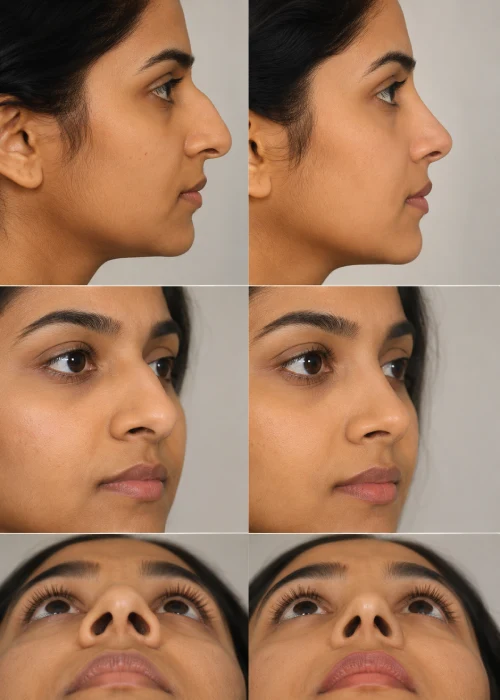
Realistic expectations matter more here than in any other operation. The goal is a balanced, natural nose that suits your face and preserves your ethnic character — refinement, not transformation. Thick skin sets a genuine ceiling on definition, and any surgeon who promises a sharply chiselled tip on thick skin is overselling.
Types of Rhinoplasty Surgery
| Type | What it addresses |
|---|---|
Reduction |
Dorsal hump, over-projection. Less commonly the main need in Indian noses |
Augmentation |
Low dorsum, saddle deformity — uses cartilage grafts |
Tip rhinoplasty |
Bulbous, drooping or under-projected tip via suturing and grafts |
Alar base reduction |
Wide nostrils or flaring; performed conservatively and usually last |
Septorhinoplasty |
Shape plus breathing in one operation |
Post-traumatic |
Deviation, collapse or airway blockage after injury |
Revision (secondary) |
Correction after previous rhinoplasty — the most complex category |
Preservation rhinoplasty |
Preserves the natural dorsal lines rather than removing and rebuilding them; suits selected anatomy |
Ultrasonic (piezo) |
Ultrasonic instruments reshape bone precisely while sparing soft tissue; may reduce bruising and swelling |
Preservation and piezo techniques are useful tools for the right anatomy, not universally superior options — be cautious of clinics marketing them as automatically better.
Open vs. Closed Rhinoplasty: The Two Approaches
| Closed (endonasal) | Open (external) | |
|---|---|---|
| Incisions | Inside the nostrils only | Small transcolumellar incision + internal |
| External scar | None | 4–5 mm across the columella |
| Exposure | Limited | Full, direct view of the framework |
| Best for | Modest dorsal work, limited tip change | Complex tip work, grafting, deviation, revision |
| Swelling | Less; settles faster | More tip swelling, longer to settle |
The columellar scar is a fine line across the strip of skin between the nostrils. It is visible while healing, fades over 6–12 months, and is usually difficult to see at conversational distance. In darker skin it can stay pink or pigmented for longer.
Your approach is chosen by what needs changing, how much grafting is required, whether it is a revision, and how much precision the tip work demands — not by which is fashionable.
Cartilage Grafts and Nasal Implants
| Graft source | Character | Used for | Trade-offs |
|---|---|---|---|
| Septal cartilage | Straight, firm | First choice for most grafts | Limited supply; often depleted in revision cases |
| Ear (conchal) | Curved, softer | Tip onlay, alar rim support | Not strong enough for major dorsal support; small hidden scar behind the ear |
| Rib (costal) | Abundant, strong | Major augmentation, revision, saddle nose | Chest scar and soreness; small risk of warping; rare risk of pneumothorax |
| Diced cartilage in fascia | Soft, mouldable | Smooth dorsal augmentation | Some resorption; less structural strength |
Silicone and Gore-Tex (ePTFE) implants avoid a donor site and are quick to place, but carry ongoing risks of infection, extrusion through the skin, migration, capsular contracture and visibility, and these risks continue for years — sometimes decades — after surgery. Thin skin and tension increase them.
Why autologous tissue is preferred: your own cartilage integrates with living tissue, resists infection far better, and does not extrude. It costs more operating time and a donor site, and that trade is generally worth making — particularly in a hot, humid climate and in patients who may not have easy access to complex revision surgery later.
Rhinoplasty for Breathing Problems
Deviated septum
a bent partition between the nasal passages, corrected by septoplasty. Cartilage removed here often supplies grafts for the cosmetic work.
Turbinate hypertrophy
enlarged internal structures reduced by radiofrequency or submucous resection. Conservative reduction only — over-resection can cause permanent dryness, crusting and paradoxical blockage.
Nasal valve collapse
the narrowest part of the airway gives way on inspiration. Treated with spreader grafts, alar batten grafts or lateral crural support. This is a common cause of breathing problems after a purely cosmetic reduction rhinoplasty performed without structural support.
Combining
functional and cosmetic work in one operation avoids a second procedure through scarred tissue.
Insurance: the functional component may be covered where there is documented obstruction, ENT assessment and supporting imaging. The cosmetic component is not. Get written pre-authorisation and expect a split estimate.
Why Choose Dr Anirban Ghosh?
About the Surgeon
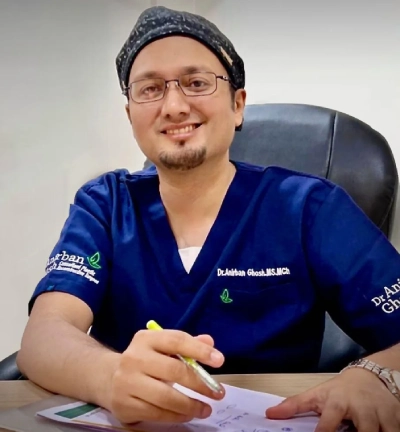
Dr. Anirban Ghosh
- MBBS (Gold Medallist)
- MS (General Surgery)
- MRCS (England)
- MCh (Aesthetic Plastic Surgery)
15+ Years of Experience
in aesthetic & reconstructive plastic surgery
50000+ Patients
Affiliations
- Indian Association of Aesthetic Plastic Surgeons (IAAPS)
- The Association of Plastic Surgeons of India (APSI)
Awards & Recognitions
- Honoured with the Indian Icon Best Healthcare Entrepreneur Award
- Esteemed Recipient of the Rabindra Ratna Puraskar 2025
Are You a Candidate for Rhinoplasty?
Suitable candidates:
nasal growth complete
physically healthy
non-smoker or willing to stop
specific, realistic goals
seeking surgery for themselves.
Age: nasal growth generally completes around 15–16 in girls and 17–18 in boys. Operating earlier risks disturbing growth and the result changing as the face matures. For teenagers, both parental consent and the young person's own clearly expressed motivation are required — not a parent's wish.
Reasons to postpone or decline:
- Body dysmorphic disorder. BDD is markedly more common among people seeking rhinoplasty than in the general population. Surgery does not treat it and frequently worsens distress. Screening is a normal, non-judgemental part of a responsible consultation, and referral for psychological support is the right outcome — not a rejection.
- Unrealistic or externally driven expectations; wanting a specific celebrity's nose
- Active smoking or cocaine use; bleeding disorders; uncontrolled hypertension or diabetes; untreated autoimmune conditions affecting the nose; major untreated obstructive sleep apnoea
- Recent nasal trauma or infection still settling
Your Consultation and Planning
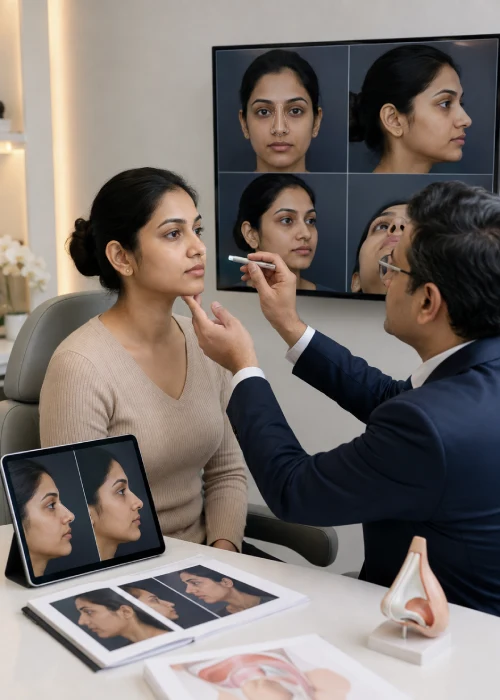
Facial analysis and standardised photographs — frontal, lateral, oblique and basal views assessing the nose in the context of your whole face.
Digital simulation is a communication tool, not a promise. It shows a direction of travel, not a guaranteed outcome, and should be documented and consented as such. Treat any clinic presenting a simulation as a commitment with caution.
Nasal and airway examination — septum, turbinates, internal and external valves, skin thickness and cartilage strength. Anyone planning your cosmetic surgery without examining inside your nose is not planning it properly.
Blood tests and pre-anaesthetic review as indicated.
Informed consent covering the likely result, the possibility of revision, and the specific risks listed below.
How to Prepare for Nose Surgery
- Stop smoking and nicotine at least 4 weeks before and after — it impairs healing and skin blood supply.
- Pause blood thinners, aspirin, NSAIDs and supplements such as fish oil, vitamin E, ginkgo and high-dose garlic on your surgeon's schedule. Never stop prescribed medication independently.
- Avoid alcohol for a week either side.
- Plan 2 weeks off work, and longer before any public-facing or physical role.
- On the day: fast as instructed, wear a front-opening top, remove contact lenses and jewellery, bring reports and medication list, arrange someone to take you home and stay overnight.
The Rhinoplasty Procedure Step by Step
Anaesthesia
general anaesthesia for most rhinoplasty.
Incisions
inside the nostrils, with a small columellar incision if open.
Reshaping
bone is refined and repositioned with controlled osteotomies; cartilage is trimmed, sutured or repositioned.
Graft harvest and placement
septal, ear or rib cartilage shaped and fixed to build dorsal height, tip support or airway support.
Tip refinement
sutures, columellar strut or septal extension graft set projection, rotation and definition.
Alar base adjustment
conservative, performed last once the tip is set.
Closure, splint and taping
external splint for about a week; internal splints occasionally; traditional packing is largely avoided now.
Duration: primary rhinoplasty typically 2–3 hours; complex, rib-graft or revision cases 3–5 hours or more. Discharge: same day or after one night.
Recovery After Rhinoplasty
| Period | What to expect |
|---|---|
| First 48 hours | Blocked nose, facial swelling, bruising around the eyes. Head elevated, cold compresses, no nose-blowing |
| Days 3–7 | Bruising peaks then fades. Splint and sutures removed around day 6–8 |
| Week 2 | Most people return to desk work. Residual swelling; concealer usually enough |
| Weeks 3–4 | Light activity resumes. Nose still swollen, especially the tip |
| Months 1–3 | Roughly 70–80% of swelling resolved; shape emerging |
| Months 3–6 | Continued refinement; profile largely settled |
| Months 6–12 | Tip definition arrives last — slowest in thick skin |
| After 12 months | Final result. Thick skin and revision cases may take 18–24 months |
Practical rules: use saline rinses as directed · tape at night if instructed · keep glasses off the nasal bridge for 4–6 weeks (tape them to the forehead or use cheek-supported frames) · light exercise from 2–3 weeks, strenuous exercise from 4–6 weeks, contact sports not before 3–6 months · flying is usually fine after 1–2 weeks · protect the nose from sun to prevent scar and skin pigmentation.
Risks and Complications
| Complication | Notes |
|---|---|
| Expected effects | Swelling, bruising, congestion, tip numbness, mild pain — all normal |
| Bleeding | Usually minor; significant epistaxis is uncommon but needs urgent review |
| Infection | Uncommon; higher risk where implants are used |
| Persistent tip swelling | Especially in thick skin; can take 18–24 months to settle |
| Breathing difficulty / valve collapse | Often follows reduction without structural support |
| Polly beak deformity | Supratip fullness from soft tissue or cartilage excess |
| Inverted-V deformity | Visible edge from mid-vault collapse after hump removal without spreader grafts |
| Open roof deformity | Flat, wide bridge when the bony roof is not closed with osteotomies |
| Saddle nose | Collapse from over-resection of dorsal septal support — serious and difficult to correct |
| Septal perforation | Causes whistling, crusting and bleeding |
| Implant extrusion or infection | A long-term risk specific to silicone and Gore-Tex |
| Sensation and smell changes | Usually temporary; permanent change is rare |
Rhinoplasty has one of the highest revision rates in plastic surgery — commonly quoted around 5–15% even in experienced hands. The nose heals in three dimensions with scar tissue that is not fully predictable, and millimetres are visible. Any surgeon claiming they never need to revise is not being straight with you.
Minimising revision comes from structural rather than reductive technique, preserving and rebuilding support instead of only removing tissue, conservative alar and turbinate work, honest pre-operative planning, and accepting a natural result over an aggressive one.
Seek urgent review for heavy bleeding, fever, spreading redness, severe one-sided pain, sudden vision change or a dusky, discoloured area of nasal skin.
Revision Rhinoplasty
Considered when there is a genuine structural or aesthetic problem, a breathing difficulty, or a deformity that has not settled with time.
Wait at least 12 months. Swelling must resolve and scar tissue must soften — operating early means operating on a nose that has not finished changing, and risks making things worse.
Revision is harder than primary surgery: scarred, less predictable tissue planes; distorted or missing anatomy; septal cartilage often already used, so ear or rib grafts are needed; thinner skin that shows every irregularity; and less predictable healing. It should be undertaken by a surgeon who does this work regularly.
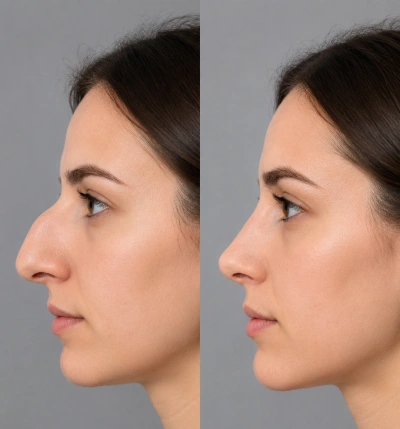
Osteotomies: What "Breaking the Nose" Actually Means
This is the single most common fear patients bring to consultation, and the phrase is misleading.
Osteotomies are controlled, planned cuts in the nasal bones made with fine instruments — not a fracture. They allow the bony sides of the nose to be narrowed or straightened, or the bony roof to be closed after a hump is removed.
They are not needed in every rhinoplasty. Tip-only work, most augmentation and much cartilage reshaping require none.
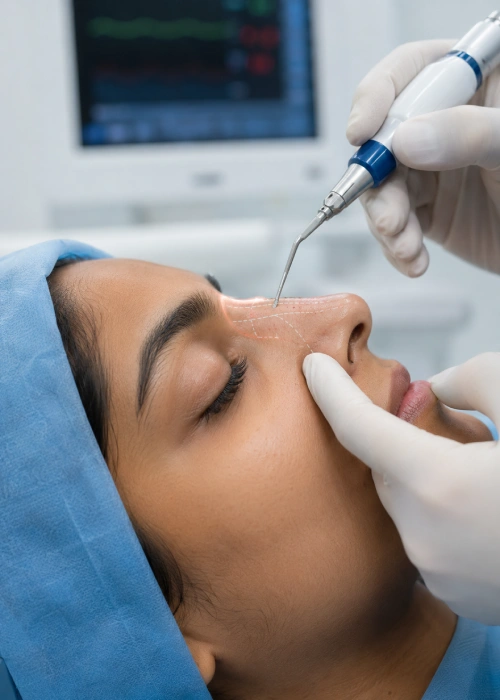
Ultrasonic (piezo) instruments can perform these cuts with greater precision and less injury to surrounding soft tissue, which may reduce bruising and swelling.
You will not feel or hear anything — this is done under general anaesthesia. Post-operatively it feels like pressure and congestion rather than the pain patients anticipate.
Where osteotomies are performed, the external splint holds the bones in their new position for about a week, and heavy contact must be avoided for three to six months.
Choosing a Rhinoplasty Surgeon in Kolkata
MCh (Plastic Surgery) is the recognised superspecialty qualification; suitably fellowship-trained ENT facial plastic surgeons also perform this work. Verify registration on the NMC or State Medical Council register.
Ask: How many rhinoplasties a year, and how many revisions? Can I see results on patients with skin as thick as mine? What grafts will you use and why? Do you use implants — and what happens if one extrudes? Will you address my breathing? What is your revision policy and cost?
Red flags: guaranteed results · a digital simulation presented as a promise · no internal nasal examination · no discussion of breathing · silicone implants recommended without discussing extrusion risk · pressure to book immediately · a quote given without an in-person assessment · results shown only on thin-skinned, non-Indian noses.
Visiting Our Clinic in Kolkata
Anirvana Clinic
8/29 Fern Road, Ballygunge Gardens, Gariahat Kolkata, West Bengal 700019
Phone
+91 6289109687
Consultation hours
| Day | Hours |
|---|---|
| Monday | 10:00 am – 10:30 pm |
| Tuesday – Saturday | 9:00 am – 9:30 pm |
| Sunday | Closed |
Hours may vary on public holidays.
Areas served
Patients travel to the Ballygunge clinic from Gariahat, Ballygunge, Dhakuria, Rashbehari, Kasba, Jadavpur, Tollygunge, Alipore, Park Street, Salt Lake, New Town, Behala, Howrah and across South and North Kolkata — as well as from Durgapur, Asansol, Siliguri and other districts of West Bengal, and from Bihar, Jharkhand, Odisha and Assam.
Travelling from outside Kolkata? Discuss the follow-up schedule before booking travel.
Frequently Asked Questions (FAQs)
How painful is rhinoplasty?
Most patients report pressure and blockage rather than pain. Discomfort is generally well controlled with oral painkillers for the first few days; the blocked-nose feeling is usually the bigger nuisance.
When will you see your final result?
The nose looks much better once the splint comes off at about a week, but 70–80% of swelling settles by three months and the final tip definition takes 12 months — often 18–24 months with thick skin.
Will there be a visible scar?
Closed rhinoplasty leaves no external scar. Open rhinoplasty leaves a 4–5 mm line across the columella that usually fades to near-invisibility over 6–12 months.
Can rhinoplasty fix your breathing too?
Yes. Septoplasty, turbinate reduction and nasal valve support are commonly combined with cosmetic reshaping in one operation.
Is any part of it covered by insurance?
The functional component may be, with documented obstruction and ENT assessment. The cosmetic component is not. Obtain written pre-authorisation.
What is the right age for rhinoplasty?
Once nasal growth is complete — generally around 15–16 in girls and 17–18 in boys. Teenagers also need parental consent and genuine personal motivation.
Will my nose look "done"?
That is a planning decision, not an inevitability. Conservative, structurally supported technique that respects your existing features produces a natural result; aggressive reduction is what produces an operated look.
Do we use silicone implants?
Autologous cartilage is preferred because it integrates with your tissue and does not extrude. Implants are discussed case by case with their long-term risks made explicit.
How much does rhinoplasty cost in Kolkata?
It depends on complexity, graft source, operating time, anaesthesia and facility. Rib-graft and revision cases cost more. Request a written, itemised estimate at consultation.
When can you wear glasses again?
Keep weight off the nasal bridge for 4–6 weeks. Tape glasses to the forehead or use cheek-supported frames in the meantime; contact lenses are fine once eye swelling settles.
When can you fly?
Usually 1–2 weeks after surgery, once acute swelling has settled. Check with your surgeon before booking.
Will your nose be broken during surgery?
Not in the way people imagine. Where the bony sides need narrowing or straightening, the surgeon makes controlled, planned cuts called osteotomies under general anaesthesia. Many rhinoplasties — particularly tip work and augmentation — need none at all.
Why do so many rhinoplasties need revision?
The nose heals unpredictably in three dimensions, scar tissue behaves differently in each patient, and very small changes are visible. Revision rates of roughly 5–15% are reported even among experienced surgeons.
Can you have rhinoplasty if you've had it before elsewhere?
Yes, but wait at least 12 months from the previous surgery. Bring your earlier operative notes and pre-operative photographs — they materially change the plan.
Request An Appointment
Visit us
Anirvana Clinic
Ballygunge, Kolkata — just off Rash Behari Avenue
References and Medical Sources
- American Society of Plastic Surgeons (ASPS) — Rhinoplasty clinical guidance.
- American Academy of Facial Plastic and Reconstructive Surgery (AAFPRS) — Rhinoplasty and revision rhinoplasty resources.
- Rohrich RJ, Ahmad J — Rhinoplasty: contemporary principles and techniques, Plastic and Reconstructive Surgery.
- Toriumi DM — Structural approach to primary and revision rhinoplasty.
- ENT UK / NICE — Septoplasty and nasal airway obstruction guidance.
- Published literature on ultrasonic (piezoelectric) osteotomy and dorsal preservation techniques in rhinoplasty.
- Association of Plastic Surgeons of India (APSI) — Practice standards.
- Published literature on body dysmorphic disorder prevalence in aesthetic surgery populations.